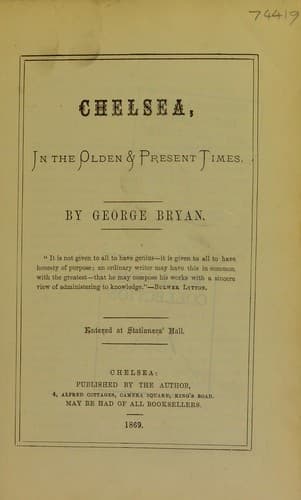
Chelsea, in the Olden & Present TimesBryan, George
History
Chelsea, in the Olden & Present Times
Bryan, George
Chelsea (London, England) -- History
There was formerly a Ferry a little eastward of the spot where now stands
Battersea Bridge, and consequently not far distant from the distinguished
mansion just described. It belonged to Thomas, Earl of Lincoln, who sold
it in 1618 to William Blake. After some time it became the property of
Sir Walter St. John, and passed with the Bolingbroke estate to Earl
Spencer, under whom it was held in 1766, when an Act of Parliament was
obtained for building a bridge over the Thames, from Chelsea to
Battersea, and empowering Lord Spencer to build the same. Fifteen
proprietors having subscribed a sum of money each, it was accordingly
begun in 1771, was opened for foot-passengers in the same year, and in
the following year was ready for carriages. From 1772, when the bridge
was finally erected, to the present time, 1869, is exactly 97 years, and
this is the precise age of it. It is a most unsightly structure of wood,
about one furlong in length, 28 ft. wide, and its cost rather more than
£20,000. The proprietors have a vote for the counties of Middlesex and
Surrey.
* * * * *
Lamps were first placed on the bridge in 1799, and in 1821 and 1822 an
iron railing 4-ft. high, on the western side, was substituted for the
original wooden railing, and in 1824, the eastern side was completed. So
far apart were the original wooden railings, which were placed crossways,
that the body of a child might have passed through them, and, if not
observed, no person cognizant of the fatal accident. There were also, at
the above period, eight projecting recesses, four on each side,
constructed for the safety of foot-passengers, and a slightly raised
pathway made.
* * * * *
The number of lives that have been sacrificed at this bridge, together
with the barges sunken at it, even within the last few years, is really
painful to contemplate. It is a sad contrast, in every respect, to the
elegant structures that now span the river, and it is to be hoped there
will soon be erected another one in its place—one that will be an
ornament to Chelsea, Battersea, and the metropolis.
HYDE PARK ON THE THAMES.
That part of the river, known as Chelsea Reach, was so fashionable a
rendezvous of pleasure boats and barges in the reign of Charles II. that
some persons have described the scene as being a sort of Pall Mall
Afloat, and it was called “Hyde Park on the Thames,” in that king’s
reign. The reach is the widest of any part westward of London Bridge,
which rendered it peculiarly suitable for such grand aquatic displays.
There were dukes and duchesses, marquises, earls, and barons, with a
similar fashionable throng to that which may still be witnessed in Hyde
Park. The watermen were arrayed in dresses of all colours, and the whole
presented a scene of grandeur which cannot be adequately described.
* * * * *
Public-domain text, read in full here on John Shaqi.
Reviews
Reviews
No reviews yet
Be the first to share your thoughts on this work.
Join the Discussion
Join the discussion
Sign in to leave a comment or review.
Sign InorCreate an account