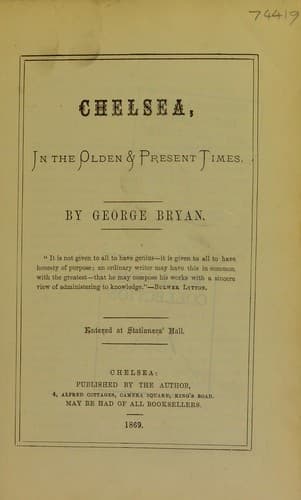
Chelsea, in the Olden & Present TimesBryan, George
History
Chelsea, in the Olden & Present Times
Bryan, George
Chelsea (London, England) -- History
Henry Sampson Woodfall, Esq., was born in Little Britain, in 1739, and
when he retired from the active affairs of life, he took a house in
Lombard Street, near the Old Church. At a very early age he had the
honour of receiving from Mr. Pope half-a-crown for reading to him, with
much fluency, a page of Homer. When twelve years old he was sent to St.
Paul’s School, on leaving which he was apprenticed to his father, a
printer in Paternoster Row; and at the age of nineteen he had committed
to his charge the whole business of editing and printing the “Public
Advertiser.” From this period till the beginning of 1793, he continued
constantly in the exercise of this laborious function. During so long a
time, when parties ran extremely high in politics, it is not surprising
that a printer should have gotten into some difficulties. He used
jocularly to say to his Chelsea friends that he had been fined and
confined by the Court of King’s Bench; fined by the House of Lords and
Commons, and indicted at the Old Bailey. He laid particular emphasis on
the words “fined” and “confined.” His conduct respecting those
celebrated letters, signed JUNIUS, displayed great integrity and
disinterestedness of character. He associated much with Garrick,
Coleman, Bonnel, Thornton, Smollett, Goldsmith, and other wits of his
day, and his own conversation overflowed with interesting anecdotes.
* * * * *
In this street resided for many years Mr. W. Lewis, bookbinder, the
intimate friend of Dr. Smollett, and his fellow companion, on their
journey from Edinburgh to London. It was by the advice of Smollett that
he settled at Chelsea; he is pourtrayed in the novel of “Roderick
Random,” under the character of Strap the Barber, and many facetious
anecdotes are there related of his simplicity, vanity, and ignorance of
the world. Mr. Lewis died about 1785.
* * * * *
Danvers Street was begun to be built in the latter end of the 17th
century, on the site of Danvers Gardens, and from thence takes its name.
Danvers House adjoined Sir Thomas More’s estate, if it was not actually a
part of his property, or that of his son in-law, Roper; there existed
anciently a thoroughfare or private way between the houses in Lombard
Street, on the north side, towards the King’s Road, but to what extent
cannot now be ascertained.
* * * * *
Public-domain text, read in full here on John Shaqi.
Reviews
Reviews
No reviews yet
Be the first to share your thoughts on this work.
Join the Discussion
Join the discussion
Sign in to leave a comment or review.
Sign InorCreate an account