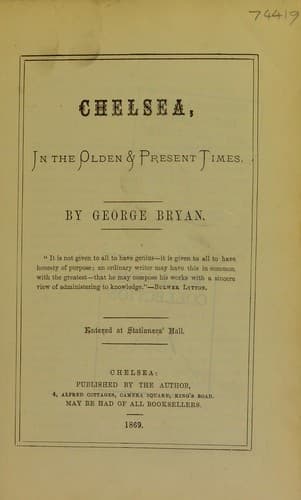
Chelsea, in the Olden & Present TimesBryan, George
History
Chelsea, in the Olden & Present Times
Bryan, George
Chelsea (London, England) -- History
Danvers House passed from the Danvers family to the Hon. T. Wharton, who,
by Queen Anne, in 1714, was created Marquis of Wharton. The house was
pulled down about 1716. The garden and grounds extended to the King’s
Road; considerable remains of this house were discovered on the site of
Paultons Square in 1822, consisting of the foundations of walls, the
remains of the great bath, and various fragments of stone pillars and
capitals, the whole covering a great space of land, but being considered
by the proprietor, Mr. Shepherd, nurseryman, too extensive to take up,
they were again covered with earth. It was Sir John Danvers who first
introduced into this country the Italian method of horticulture, of which
his garden was a most beautiful specimen. Against the wall of the house
at the south end of Danvers Street, is placed a stone thus
inscribed:—“This is Danvers Street, begun in ye year 1696 by Benjamin
Stafford.” In 1742 this was a public house, the sign of the Bell, which
was suspended across the street. The house at the south-west corner was
also, it is said, formerly a public house, known by the sign of the
Angel.
* * * * *
Duke Street, as already indirectly intimated, was first built at the time
when the Duke of Buckingham resided at the “greatest house in Chelsea,”
and was thus named in compliment to that nobleman. There is nothing
clearly known as to the origin of Lombard Street.
* * * * *
Luke Thomas Flood, Esq., first resided in Cheyne Walk, but afterwards
removed to the spacious house at the western corner of Beaufort Street,
fronting the river. He was a very great benefactor to the parish, an
active and intelligent magistrate, and interested himself in promoting at
all times whatever was conducive to the welfare and improvement of
Chelsea. He was treasurer of the Parish Schools for many years, and, in
1818, through his indefatigable exertions, he succeeded in nearly
doubling the number of children that had attended them, and who were
clothed and educated free of expense to their parents. Towards the close
of his life he went to Brighton, where he remained till his death, which
occurred about 1860. His munificent annual gifts to the poor of this
parish, as bequeathed in his will, but which he desired to be at once
carried into effect, during his remaining days, will cause his memory to
be revered in this parish by all future generations. Mr. Flood possessed
some valuable pictures by the most eminent Masters.
* * * * *
Public-domain text, read in full here on John Shaqi.
Reviews
Reviews
No reviews yet
Be the first to share your thoughts on this work.
Join the Discussion
Join the discussion
Sign in to leave a comment or review.
Sign InorCreate an account