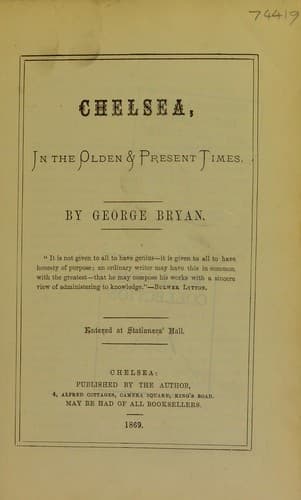
Chelsea, in the Olden & Present Times — John Shaqi
Chelsea, in the Olden & Present TimesBryan, George
History
Chelsea, in the Olden & Present Times
Bryan, George
Chelsea (London, England) -- History
Count Zinzendorf, who was the purchaser, formed an intention of
establishing a settlement at Chelsea for the Moravians, and took a plot
of ground to erect a large building for the reception of three hundred
families, to carry on a manufactory; and, besides possessing Lindsey
House, he also purchased a piece of ground, part of the gardens of
Beaufort House, for a burial ground, together with the stables belonging
to that old mansion, and likewise a slip of ground to erect a chapel.
The chapel was fitted up, but the settlement, which was to be called
Sharon, failed. The house was, however, inhabited by some of the
society. Count Zinzendorf himself lived there, and presided over the
community as long as he dwelt in England. In 1754 an English provincial
Synod was held here, at which the minister of the brethren’s church at
London, John Gambold, a divine greatly esteemed for his piety and
learning by several English bishops, who were his cotemporaries at
Oxford, was consecrated a bishop of the church of the brethren; he had
previously published a hymn book for the children belonging to the
brethren’s congregation, printed entirely with his own hands at Lindsey
House. The inmates of the house consisted chiefly of Germans and
missionaries, for whose use the Count principally intended the
establishment, that they might make it a sort of caravansera or resting
place when they arrived in this country, in passing to or from their
various missionary establishments in the British dominions. The panels
of the great staircase, being wainscotted, were painted by Haidt, a
celebrated German artist; there were also in the house several admirable
portraits. The house was sold by the society in 1770. There has not
been any other settlement for the Moravians since that period. Their
church is episcopal and has been acknowledged as such by Parliament.
They live, in their settlements, like members of one large family; the
most perfect harmony prevails amongst them, and they seem to have but one
wish at heart, the propagation of the Gospel and the general good of
mankind.
* * * * *
The Moravian Burial Ground, the entrance to which is at the north end of
Milman’s Row, occupies about two acres of ground. The whole is divided
into four distinct compartments. The brethren are buried in separate
divisions from those of the sisters; for, as in their public assemblies,
they still adhere to the ancient custom of separating the sexes, the men
occupying one, and the women the other side of the chapel, so they retain
it even in their burying ground. The tomb-stones are all flat, placed on
turf, raised about six inches above the ground, in regular rows. The
inscriptions in general record only the names and age of the persons
interred. Amongst them are the following:—
* * * * *
Public-domain text, read in full here on John Shaqi.
Reviews
Reviews
No reviews yet
Be the first to share your thoughts on this work.
Join the Discussion
Join the discussion
Sign in to leave a comment or review.
Sign InorCreate an account