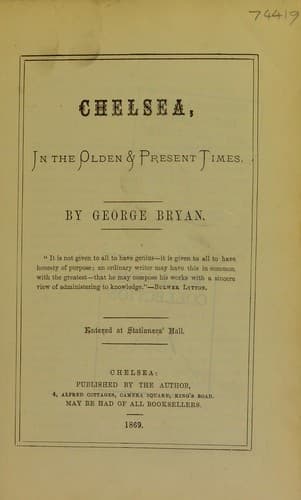
Chelsea, in the Olden & Present TimesBryan, George
History
Chelsea, in the Olden & Present Times
Bryan, George
Chelsea (London, England) -- History
The Rev. J. G. Gregory, M.A., succeeded Mr. Goodhart at the close of the
year 1868. The body of the chapel, since his appointment, has been
entirely re-pewed, the old high pews having been all removed, and the
seats made more commodious by additional width being given to them.
Several other alterations have been made, and a few more are said to be
in contemplation. The whole interior of the chapel is therefore now
greatly improved, both as regards comfort and appearance. The exterior
of the structure, however, requires to be altogether rebuilt, as soon as
practicable, so as to accord with the ecclesiastical architecture of the
present day, especially in such a locality as West Brompton and South
Kensington. In the Vestry Room are portraits of the different Ministers
of Park Chapel, commencing with the Rev. John Owen, and terminating with
the Rev. Mr. Goodhart, with only one exception, the portrait of Mr.
Vaughan, the absence of which may be attributed to the short period of
his ministry, in consequence of his illness and death, and the difficulty
afterwards of procuring a correct likeness of him. It would be well if
this memorial portrait could be added to the others.
Their Royal Highnesses the Dukes of Kent and Sussex attended this chapel
in 1812, when a collection was made for the benefit of the schools, on
which occasion a guard of honour, selected from Queen Charlotte’s Royal
Volunteers, was stationed at the doors on their arrival and departure.
* * * * *
Adjoining the chapel a building was erected, in 1828, by subscription,
and the profits of a sale of fancy work, for the reception of the
children of Park Chapel Schools, &c. The whole charge originally was
£900. Several alterations, however, have since been made in the
arrangement of this building. The Girls’ Day and Sunday Schools, and the
Infant School, are now only held in it, besides a few occasional meetings
in connection with the numerous benevolent societies supported by the
liberal contributions of the congregation. The boys’ school was
transferred to the Clock House some years since. This latter school owes
its origin to Samuel Gower Poole, Esq., who once resided in Dudmaston
House, King’s Road, and to whom reference has already been made. The
annual meetings. &c., are also held in the Clock House schoolroom.
CHELSEA PARK.
This was part of the property of Sir Thomas More, and is called, in old
deeds, the “Sand Hills;” was originally open fields, with a footpath
across to Little Chelsea. The whole was enclosed with a brick wall, in
1625, by the Lord Treasurer, Cranfield, and converted into a park, which
name it has retained ever since, but the walls have gradually given way
to the erection of buildings. The park originally consisted of 32 acres,
situated north of the King’s Road, between Park and Upper Church Street.
{71}
* * * * *
Public-domain text, read in full here on John Shaqi.
Reviews
Reviews
No reviews yet
Be the first to share your thoughts on this work.
Elsewhere in the archive
Join the Discussion
Join the discussion
Sign in to leave a comment or review.
Sign InorCreate an account