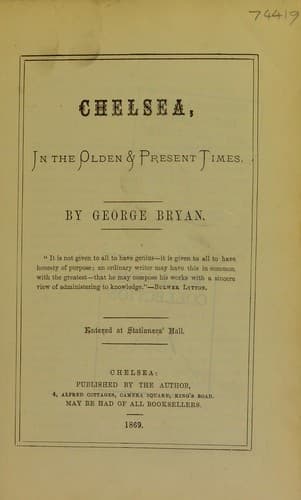
Chelsea, in the Olden & Present TimesBryan, George
History
Chelsea, in the Olden & Present Times
Bryan, George
Chelsea (London, England) -- History
In 1721 a patent was obtained for a manufactory of raw silk, and this
park was taken for the purpose, and planted with mulberry trees. It
attracted a considerable share of public attention at the time, but
proved unsuccessful. The premises of the Raw Silk Company were rated in
the parish books at £200.
* * * * *
In Walpole’s Catalogue of Engravers, it is stated that James Christopher
le Blon, in 1734, set up a project for copying the cartoons in tapestry,
and made some fine drawings for the purpose. Houses were built, and
looms erected, on the above mulberry ground, but either the expense was
too great, or the contributions did not arrive fast enough. The bubble
burst, several suffered, and Le Blon was heard of no more.
* * * * *
INTERESTING PARTICULARS OF SIR HENRY AND LADY WILSON. On the northern
border of the old park, just described, is a capital mansion in which Sir
Henry Wright Wilson resided for many years, the entrance to it being in
the Fulham Road, and which is still designated as Chelsea Park. The
pleasure grounds attached to it were some years since much more extensive
than they are at present. Sir Henry married a daughter of the Earl of
Aylesbury, who was left a valuable estate in Hampshire, said to be worth
about £3000 a year, under the most singular circumstances. Lady Frances
Wilson was informed in the year 1824, while at breakfast, that an
eccentric person named Wright, who had died a few days previously at an
obscure lodging in Pimlico, had appointed her and Mr. C. Abbot his
executors, and after some legacies had bequeathed to Lady Frances the
residue of his property by a will dated as far back as 1800. As Lady
Frances declared herself unacquainted with the name of the testator, she
at first concluded that there was some mistake. After further
explanation, the person of Mr. Wright was described to her, and Lady
Frances recollected that the description answered that of a gentleman she
had remembered as a constant frequenter at the Opera many years
previously. To satisfy herself of the identity she went to Mr. Wright’s
late lodgings, and saw him in his coffin, when she recognised the
features as those of the person whose eyes had so often persecuted her
when she was Lady Frances Bruce, but who had never spoken to her, and of
whom she had no knowledge whatever. {72} Lady Francis was never
considered by her friends to be beautiful, and the general opinion at the
time was that the legacy was intended for a lady who occupied a box next
to that in which Lady Frances sat when at the Opera. Sir Henry was in
Parliament when the above estate came into his wife’s possession, but he
afterwards had to contest his seat, and lost it.
* * * * *
Public-domain text, read in full here on John Shaqi.
Reviews
Reviews
No reviews yet
Be the first to share your thoughts on this work.
Elsewhere in the archive
Join the Discussion
Join the discussion
Sign in to leave a comment or review.
Sign InorCreate an account