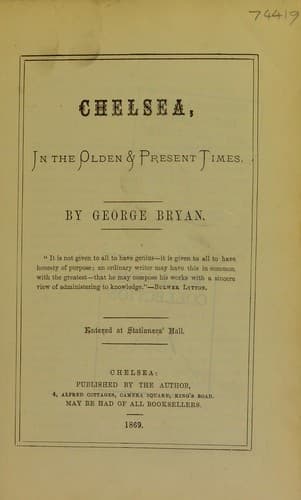
Chelsea, in the Olden & Present TimesBryan, George
History
Chelsea, in the Olden & Present Times
Bryan, George
Chelsea (London, England) -- History
Francis Hargrave, Esq., a barrister, resided in York Place, (the houses
of which are now nearly all converted into shops, and which is situated
near to the Jews’ Burial Ground), for a considerable period. He
particularly distinguished himself in the _Habeas Corpus_ case of James
Somerset, a negro, for whom he was counsel, and his argument was the
occasion of a precedent being established for the freedom of slaves the
moment they set foot on English land. He possessed a very extensive and
most valuable library, which Parliament purchased for £8000, in order
that it might be placed in the British Museum. He died here in 1821,
aged 80.
* * * * *
Sydenham Edwards, Esq., F.L.S., an eminent botanical draughtsman, lived
in Charles Street, Queen’s Elm, and afterwards removed to Barrossa Place,
where he died in 1819. The Flora Londinensis, Rees’ Encyclopædia, &c.,
were greatly indebted to his masterly pencil.
CHURCH STREET.
Alexander Stephens, Esq., built and resided in Park House, Upper Church
Street, for a great many years. He was the author of several popular
works, was born at Elgin, about 1757, and completed his education at the
University of Aberdeen, which he left at the early age of 18 years, for
the purpose of proceeding to the West India Islands, principally with a
view to add to his stock of useful information and knowledge of the
world. Mr. Stephens purchased a Commission in the 84th regiment, but
never joined in consequence of the sudden reduction of that corps. At
the age of 21, he entered himself a member of the Middle Temple, where he
continued his vigorous pursuit of legal studies for several years. His
earliest production was “Jamaica,” a descriptive poem; and his next,
published within a few years afterwards, “The Temple,” a kind of law
journal. But of his printed works, undoubtedly, the most approved are
the volumes of the “Public Characters;” also a “Life of John Horne Took,”
and the “History of the Wars, which arose out of the French Revolution.”
* * * * *
The industry of Mr. Stephens in the collection of the materials for his
biographical works has not often been surpassed. He was accustomed to
commit to paper the most trifling memoranda illustrative of the history
of any eminent individual the moment they were communicated to him.
* * * * *
Mr. Stephens enjoyed the confidential friendship of the late Duke of
Kent, and was in habits of unreserved intimacy with many other
distinguished characters of the age. He was related to the Duke of
Roxburgh, whose claim to that title he pleaded with memorable success in
the House of Lords.
* * * * *
Although generally of retired habits, Mr. Stephens often felt interested
in the parochial concerns of Chelsea, and distinguished himself by the
manliness and zeal with which he supported measures which to him appeared
likely to prove beneficial.
Public-domain text, read in full here on John Shaqi.
Reviews
Reviews
No reviews yet
Be the first to share your thoughts on this work.
Elsewhere in the archive
Join the Discussion
Join the discussion
Sign in to leave a comment or review.
Sign InorCreate an account