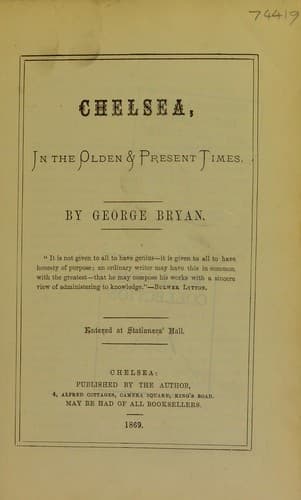
Chelsea, in the Olden & Present TimesBryan, George
History
Chelsea, in the Olden & Present Times
Bryan, George
Chelsea (London, England) -- History
Mr. Martyn’s propensity to the science of botany was first excited by an
acquaintance with Mr. Wilmer, an apothecary, who afterwards became the
reader in the Botanic Garden at Chelsea, and by an intimacy contracted
with Dr. Blair and Dr. Sherard. In the year 1732, he published a
translation of “Tournefort’s History of Plants about Paris,” and in the
same year a “Catalogue of the Plants about London,” but he did not
complete it. From a strong conviction that observations made upon plants
in their natural places of growth were the least liable to error, he
about the same time began his botanical excursions, which were mostly
performed on foot, and were continued for a long period with unwearied
diligence. His “Hortus Siccus,” containing 1,400 specimens, is a
sufficient testimony of his industry. Nor did he confine himself wholly
to the contemplation of vegetables, and their hidden virtues; the
numerous insect tribe began to attract no small share of his attention.
In 1721, he principally instituted the Botanical Society, in London. Dr.
Dillenius was president, and Mr. Martyn was secretary. This society kept
together till 1726. About this time he became a member of the Royal
Society, and now began to apply himself most seduously to the practice of
physic. For this purpose he was admitted of Emmanuel College, Cambridge,
and kept five terms, with an intention to have proceeded regularly with
his degrees, but from peculiar circumstances he was prevented from
finishing his design. He had now lived and practised physic in Great St.
Helen’s, Bishopsgate Street, during three years; but, finding the air of
London disagree with his constitution, he embraced a favourable
opportunity which offered of removing to Chelsea, where he practised
physic with success and great reputation for above twenty years.
In 1733, he was chosen Professor of Botany in the University of
Cambridge, where he had given several courses of lectures, and had
greatly restored the study of that science.
Mr. Martyn, in 1723 (as is stated in a preceding page), married Eulalia,
youngest daughter of the Rev. Dr. John King, Rector of Chelsea, by whom
he had three sons and five daughters, all of whom were born in Church
Street, Chelsea, in the same house wherein their mother was born and
died, and in which her father, Dr. King, lived and died. Mrs. Martyn
died in 1749, from a cancer in her breast, occasioned by a violent blow
given her as she was walking in London.
* * * * *
In 1750, Mr. Martyn married, secondly, a daughter of Claude Fonnereau,
Esq., merchant of London, who bore him one son and survived him. Soon
after this he retired to Streatham, Surrey. In 1761 he resigned his
professorship of botany; and some time after presented to the University
his library of botanical books, amounting to above 200 volumes.
* * * * *
Public-domain text, read in full here on John Shaqi.
Reviews
Reviews
No reviews yet
Be the first to share your thoughts on this work.
Elsewhere in the archive
Join the Discussion
Join the discussion
Sign in to leave a comment or review.
Sign InorCreate an account