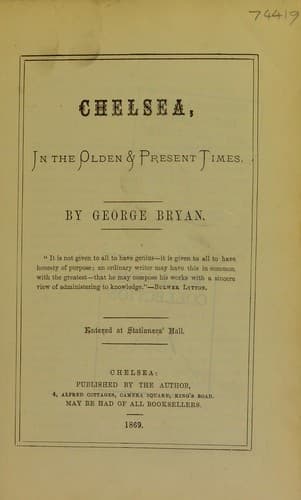
Chelsea, in the Olden & Present TimesBryan, George
History
Chelsea, in the Olden & Present Times
Bryan, George
Chelsea (London, England) -- History
Specimens of this porcelain have always been much esteemed, and still
retain a great value. At the sale of the effects of Queen Charlotte, the
articles in Chelsea china, of which her Majesty had a large collection,
brought very high prices. Mr. Watkins, in his Life of Queen Charlotte,
says, “I beheld with admiration a complete service of Chelsea china,
porcelain, rich and beautiful in fancy beyond expression. I really never
saw any Dresden porcelain near so fine.”
* * * * *
Mr. A. Stephens, whom we have already noticed, was told by the foreman of
the Chelsea China Manufactory (then in the workhouse of St. Luke’s,
Middlesex), that Dr. Johnson had conceived a notion that he was capable
of improving on the manufacture of china. He even applied to the
directors of the Chelsea China Works, and was allowed to _bake_ his
compositions in their ovens in Lawrence Street, Chelsea. He was
accordingly accustomed to go down with his housekeeper, about twice a
week, and stop the whole day, she carrying a basket of provisions with
her. The Doctor, who was not allowed to enter the _mixing_ room, had
access to every other part of the premises, and formed his composition in
a particular apartment, without being overlooked by any one. He had also
free access to the oven, and superintended the whole of the process; but
completely failed, both as to composition and baking, for his materials
always yielded to the intensity of the heat, while those of the Company
came out of the furnace perfect and complete. Dr. Johnson retired in
disgust, but not in despair, for he afterwards gave a dissertation on
this very subject in his works; but the overseer assured Mr. Stephens, in
1814, that he was still ignorant of the nature of the operation. He
seemed to think that the Doctor imagined one single substance was
sufficient, while he, on the other hand, asserted that he always used
sixteen, and he must have had some practice, as he had nearly lost his
eye-sight by firing batches of china, both at Chelsea and Derby, to which
the manufacture was afterwards carried.
* * * * *
Chelsea china, originally patronised by the Duke of Cumberland, and
afterwards by Sir R. Faulkner, was a long time in such repute as to be
sold by auction, and as a set was purchased as soon as baked, dealers
were surrounding the doors for that purpose. {87}
LAWRENCE STREET, &c.
Lawrence Street derives its name, as previously intimated, from its
having been the site of the residence of the Lawrence family for many
years. On this spot stood the first old Manor House, until Lord Sandys
alienated the manor to Henry VIII., when that king sold it to Sir Thomas
Lawrence, and erected another in Cheyne Walk.
* * * * *
Public-domain text, read in full here on John Shaqi.
Reviews
Reviews
No reviews yet
Be the first to share your thoughts on this work.
Elsewhere in the archive
Join the Discussion
Join the discussion
Sign in to leave a comment or review.
Sign InorCreate an account