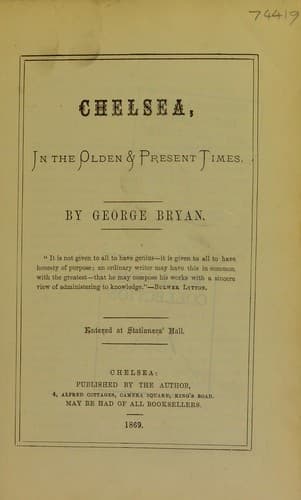
Chelsea, in the Olden & Present TimesBryan, George
History
Chelsea, in the Olden & Present Times
Bryan, George
Chelsea (London, England) -- History
The ancient family of Lawrence first came into England with William the
Conqueror, and settled at Ashton Hall, in the county of Lancaster, where
they resided for 300 years, and possessed an immense property, which, in
the year 1591, included 34 manors, the rental of which amounted to £6000
per annum. It is uncertain when this family first came to Chelsea, but
as the Lawrence chapel in the Old Church is built in the style of
architecture which prevailed at the beginning of the fourteenth century,
they were probably settled here about that period, and some time before
they purchased the manor house. Some of the family who were buried in
the chapel have already been mentioned.
* * * * *
The chief branches of this eminent family resided in Chelsea, in London,
and at Iver, Bucks. Sir John Lawrence, knight, was Lord Mayor of London
in 1665.
* * * * *
Some “Pious Contemplations,” on the arms of the Lawrence family, are
written in the margin of their pedigree. They are supposed to have been
affixed to it in 1664, but the author is not known. The following are
the concluding lines:—
“The way to Heaven is not with roses spread,
But throng’d with thorns, as was Thy sacred head;
Our peace is hack’d and hew’d, our life’s a war,
We, for our Cross, must many crosses bear—
Or, a red sea our passage doth withstand,
Or, fiery serpents, or, a barren sand,
Ere we can reach the truly Holy Land.”
“Christ’s Cross the ladder is that leads to bliss,
Blest Jacob’s vision was a type of this;
Who climbs by other steps is at a loss—
To Heaven the only ladder is the Cross.”
Ann, Duchess of Monmouth and Buccleugh, relict of James, Duke of
Monmouth, resided in the “great house” in Lawrence Street about 1714, and
from that time it was called Monmouth House. The following item appears
in the Churchwardens’ accounts for the year 1716: “Paid the ringers, when
the Princess (afterwards Queen Caroline) visited the Duchess of Monmouth,
six shillings.” The Duchess was, it is said, for her agreeable person,
good sense, and irreproachable character, one of the most amiable ladies
about the Court. During the first years of her marriage she seems to
have been as happy, and as much envied as any woman in the kingdom; but
this happiness was of short duration; she was unfortunately supplanted in
the Duke’s affections by Lady Harriet Wentworth, daughter of the Earl of
Cleveland, whose personal charms were superior to her own. Her Grace
died in 1732, aged 90 years.
* * * * *
Mr. Gay was for some time secretary to the Duchess, as stated in
Johnson’s Life of Gay.
* * * * *
Public-domain text, read in full here on John Shaqi.
Reviews
Reviews
No reviews yet
Be the first to share your thoughts on this work.
Elsewhere in the archive
Join the Discussion
Join the discussion
Sign in to leave a comment or review.
Sign InorCreate an account