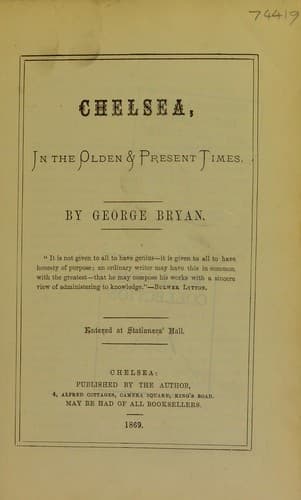
Chelsea, in the Olden & Present TimesBryan, George
History
Chelsea, in the Olden & Present Times
Bryan, George
Chelsea (London, England) -- History
In Cheyne Row, within my recollection, many old and influential families
have resided there, who were greatly respected. Amongst them may be
mentioned Edmund Chalmers, Esq., Thomas Chalmers, Esq., John Hulme, Esq.,
Edward Holl, Esq., the benevolent Mrs. Hebert, Richard Draper, Esq.,
George Blyth, Esq., and Isaac Wrentmore, Esq.
Thomas Carlyle, Esq., who is so well-known in literary and other
distinguished circles, and who is certainly one of the most profound
writers of the present age, has resided in Cheyne Row for a great many
years. The University of Edinburgh, last year, conferred on him the
highest honour it could bestow. His habits of life at Chelsea are
naturally secluded, but he is nevertheless greatly respected by those who
have an opportunity of acquiring a knowledge of his social worth. Mr.
Carlyle begins now to bend with age, although apparently in tolerable
health, and, notwithstanding his recent severe bereavement, not a cloud
seems to dim the vigour of his intellectual faculties.
In Upper Cheyne Row there was formerly a manufactory for melting gold and
silver in crucibles, which was said to produce the best articles of the
kind in England.
* * * * *
Cook’s Grounds was formerly a back way to Alston House, Cheyne Walk.
* * * * *
Cook’s Ground Chapel was originally built for the use of the French
Protestants, who had taken refuge in this country after the revocation of
the edict of Nantes, in the year 1685. Several French gardeners settled
upon this spot, and the Rev. Dr. King, the rector, mentions them in terms
of great kindness, and strongly recommends them to the protection of his
successors. The chapel was for many years in the Independent Connexion.
The Rev. Benjamin Fielder, in 1773, succeeded the Rev. Mr. Trail, and
died in 1803. His death was very affecting; he had seated himself in the
pulpit, and, after a hymn had been sung, he was observed with his head
reclining, and without any signs of life. He was immediately removed,
but never spoke afterwards. The Rev. John Bunce, who was well known and
respected in Chelsea, was minister at this chapel for many years, and
subsequently Dr. Tracey, Mr. Webb, and at the present time Mr. Hayward.
Alston House, Cheyne Walk.
Shrewsbury, or Alston House, a capital mansion, built about the latter
end of the reign of Henry VIII., was situated in Cheyne Walk, to the west
of the present “Pier Hotel.” This house was considered for a long time
to have been the residence of Sir Thomas More; but Dr. King has proved,
from the most authentic documents, that it never had any just pretensions
to that honour.
* * * * *
Public-domain text, read in full here on John Shaqi.
Reviews
Reviews
No reviews yet
Be the first to share your thoughts on this work.
Elsewhere in the archive
Join the Discussion
Join the discussion
Sign in to leave a comment or review.
Sign InorCreate an account