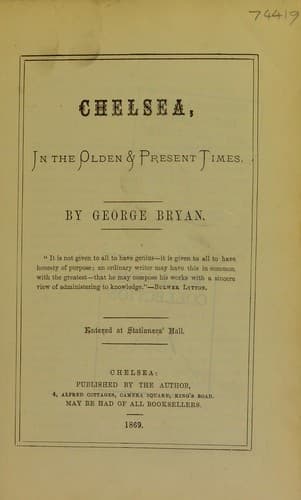
Chelsea, in the Olden & Present TimesBryan, George
History
Chelsea, in the Olden & Present Times
Bryan, George
Chelsea (London, England) -- History
It was an irregular brick building, forming three sides of a quadrangle.
The principal room was one hundred and twenty feet in length, and was
originally wainscotted with carved oak. One of the rooms was painted in
imitation of marble, and appeared to have been originally an oratory.
Certain curious portraits on panel, which had ornamented the large rooms,
were destroyed some few years since; this is to be regretted, as, in all
probability, they represented its former owners, or, at least, some
persons of note.
* * * * *
Leading from the premises, towards the King’s Road, there is a
subterranean passage, which has been explored for a short distance. It
is said, traditionally, to have communicated with a cave or dungeon,
situated at a considerable distance from the house; but for what purpose
made, no one now in its vicinity confidently presumes to guess.
* * * * *
The following information concerning this subterranean passage, is
obtained from a letter of Miss Gulston to Miss Tate, who was the
proprietor of the estate:—
“I have found an old man, now living at Chelsea, who worked at the
paper manufactory when a lad, and who has established the facts. I
have always been laughed at when I have mentioned the story. I have
gotten two drawings of the room and passage.
“The entrance to this passage was from the room used by the paper
stainers as a drying place. It had no fire-place in it; the
dimensions were nearly as follows: 25 feet high, 50 long, 36 wide;
the ceiling was strong with beams, to sustain the upper floors, but
without any plastered ceiling. You descended into it by a wide
winding staircase, through a circular-top door, strongly fortified
with rivets and four large hinges: this door was so contrived, that
it opened far enough back to hide the approach to the hole, and could
there be fastened so as to have the appearance of belonging to the
large room, and the circular steps leading to it caused the more
deception.
“The side walls are all brick. This man never could proceed with his
light more than a distance of thirty yards, when the light invariably
went out. The passage is free from any incumbrance of earth, or from
any part of the side walls having given way; as far as could be
ascertained, its direction was towards the river.
“It is regularly paved with two flag stones, leaving a border of six
inches of earth; width 3 feet, length 5½ feet.
“This passage was discovered, owing to the proprietor having been
robbed of a quantity of paper for years. The man now alive
volunteered to detect the thief; the paper was found on the staircase
descending to the passage.
“E. GULSTON.”
Alston House was for many years the residence of the Shrewsbury family.
* * * * *
Public-domain text, read in full here on John Shaqi.
Reviews
Reviews
No reviews yet
Be the first to share your thoughts on this work.
Elsewhere in the archive
Join the Discussion
Join the discussion
Sign in to leave a comment or review.
Sign InorCreate an account