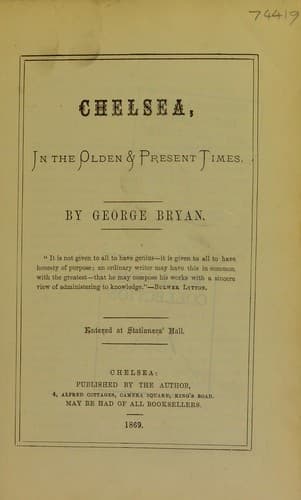
Chelsea, in the Olden & Present TimesBryan, George
History
Chelsea, in the Olden & Present Times
Bryan, George
Chelsea (London, England) -- History
Bishop Trelawney was one of the seven prelates committed to the Tower by
James II. for their efforts to maintain the Protestant cause. When the
news of his probable peril of life reached Cornwall, the miners proposed
coming up to London in a vast body to demand the bishop’s release. The
song in every mouth was—
“And shall Trelawney die?
And shall Trelawney die?
Then twice five hundred Cornish men
Will know the reason why.”
It is said that the bishop was open, generous, and charitable, a good
companion, and a good man. He died in 1721. {100}
* * * * *
Charles Trimnell, son of the Rev. Charles Trimnell, Rector of Repton
Abbotts, Huntingdonshire, was educated at Oxford. He was consecrated
Bishop of Norwich in 1707; was made Clerk of the Closet to George I., and
translated to the see of Winchester in 1721. This bishop, naturally of a
weak constitution, did not long survive his last promotion. He died at
Farnham in 1723, aged 40. This prelate was a steady partizan of the
revolution, which he defended by his pen; warm, yet temperate; zealous,
yet moderate; and his piety did not prevent him from gaining a perfect
knowledge of mankind.
* * * * *
Richard Willis, Fellow of All Souls College, Oxford, was promoted to the
deanery of Lincoln, by King William; and in 1714 was consecrated Bishop
of Gloucester, translated in 1721 to Salisbury, and thence to Winchester
in 1723, where he resided till his death, which happened suddenly at
Winchester House, Cheyne Walk, in 1734, aged 71; his wife was buried in
Chelsea Church, in 1727, but he himself was buried in his own Cathedral.
* * * * *
Bishop Hoadly, a prelate of great merit, was the son of the Rev. Samuel
Hoadly, Master of the Public Grammar School at Norwich; he was educated
at his father’s school till he went to Catherine Hall, Cambridge, where
he afterwards became College Tutor, and appears to have been held in high
esteem throughout the whole course of his academical studies. Although
he applied to study with an intensity of application that made him
eminent, he acquired at the same time considerable proficiency in music.
In 1698 he was ordained, and about three years afterwards he married Miss
Curtis, a great proficient in the art of painting, many of her portraits
exciting public attention, particularly one of Bishop Burnet.
* * * * *
Public-domain text, read in full here on John Shaqi.
Reviews
Reviews
No reviews yet
Be the first to share your thoughts on this work.
Elsewhere in the archive
Join the Discussion
Join the discussion
Sign in to leave a comment or review.
Sign InorCreate an account