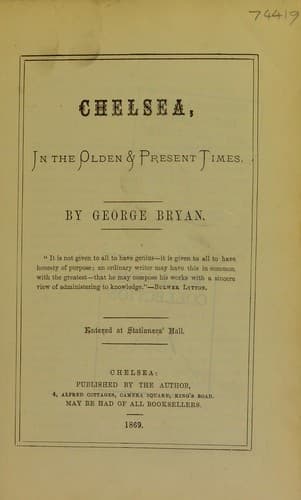
Chelsea, in the Olden & Present TimesBryan, George
History
Chelsea, in the Olden & Present Times
Bryan, George
Chelsea (London, England) -- History
In 1704 Mr. Hoadly obtained the rectory of St. Peter le Poor; he began
writing as soon as he came to London; and in 1709 the following vote was
passed in the House of Commons:—“Resolved, That the Rev. Benjamin Hoadly,
having often justified the principles on which his Majesty and the nation
proceeded in the late happy revolution, hath justly merited the favour
and recommendation of this House. That an humble address be presented to
her Majesty, that she would be graciously pleased to bestow some dignity
in the church on Mr. Hoadly, for his eminent services, both to the Church
and State.” A change of Ministry prevented any benefit arising to him
from this address; but he afterwards had bestowed on him, by the
grandmother of the Duke of Bedford, the rectory of Streatham, Surrey.
Soon after the accession of George I. he was made Bishop of Bangor. From
thence he was successively translated to those of Hereford, Salisbury,
and Winchester, which last he enjoyed nearly twenty-seven years.
* * * * *
It is somewhat a singular circumstance, that when Bishop Hoadly went to
Court to kiss the King’s hand on his promotion, he did not know the way
up stairs, the attendants being all busily engaged at the moment, and by
mistake he sat down in an outer room unobserved, and some affirm that he
lost the honour of being presented on that occasion to his Majesty.
* * * * *
The doctrines contained in his publications gave such offence to the
clergy, that they produced the famous Bangorian Controversy. On the 16th
of December, 1761, having supped, he retired to bed in perfect health,
but in the middle of the night he was seized with a fit of vomiting, of
which the violence abated in about an hour. Medical assistance was
immediately sent for, and the bishop seemed better, but about two o’clock
the following even, his lady found him dead, without knowing the precise
moment of his departure. As a writer, he possessed powerful talents; his
greatest defect, perhaps, was in extending his periods to a disagreeable
length; for which Pope has thus recorded him:—
“But, sir, of writers? Swift for closer style,
But Hoadly for a period of a mile.”
Amongst the most celebrated writers of modern times, who have possessed
great argumentative powers, this “defect” is generally a natural
consequence. Lord Brougham, for instance, was remarkable for the length
of his periods, or final sentences, but with him it evidenced deep
thought, and enabled him to impart into his writings and speeches that
eloquence and force of language for which he was so highly extolled.
Bishop Hoadly might have been one of those “powerful” writers.
* * * * *
Public-domain text, read in full here on John Shaqi.
Reviews
Reviews
No reviews yet
Be the first to share your thoughts on this work.
Elsewhere in the archive
Join the Discussion
Join the discussion
Sign in to leave a comment or review.
Sign InorCreate an account