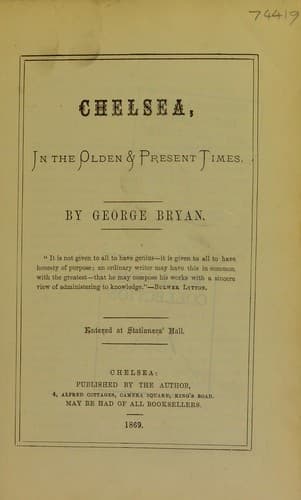
Chelsea, in the Olden & Present TimesBryan, George
History
Chelsea, in the Olden & Present Times
Bryan, George
Chelsea (London, England) -- History
Dr. John Thomas was born in 1696, and in 1733, being then Fellow of All
Souls College, Oxford, he was presented by the Dean and Chapter of St.
Paul’s, to the united parishes of St. Benedict’s and St. Peter’s, Paul’s
Wharf, London. In 1742 he became Canon Residentiary of St. Paul’s, and
was sworn in one of his Majesty’s Chaplains in Ordinary. He was
consecrated Bishop of Peterborough in 1747, and four years after was
appointed Preceptor to the Prince of Wales. On the death of Bishop
Hoadly he was presented to the see of Winchester. Dr. Thomas died at his
episcopal palace, Cheyne Walk, in 1781, aged 85, having sustained
throughout life the character of an exemplary prelate. {102}
* * * * *
The Hon. Brownlow North was born in 1741, was the younger son of the
first Earl of Guildford, and brother to that Lord North who became twice
Prime Minister of this country, once during the American war, and,
secondly, in conjunction with Mr. Fox. Mr. North was first educated at
Eton, and afterwards at Trinity College, Cambridge. In 1770 he was
promoted from a canonry at Christchurch, to the deanery of Canterbury.
His elder brother being now Prime Minister he obtained the mitre of
Lichfield and Coventry in 1771, at the early age of 30. In 1744 he was
promoted to the see of Worcester, soon after which he was promoted to the
rich see of Winchester. By his wife, formerly Miss Bannister, a lady
previously well known in the fashionable world, he had a very numerous
family, of whom both sons and sons-in-law were amply provided with
valuable livings in the church. The bishop with his family went to
Italy, and shortly after their return his lady died; his lordship died at
his palace at Chelsea, after a long illness, accompanied with blindness,
at the age of 79, July 12, 1820.
* * * * *
Bishop North was kind and charitable. The present writer gladly embraces
this opportunity to testify to the truth of this statement. The bishop
was walking in front of his palace, as was his frequent custom, when the
writer, then quite a youth, fell accidentally with considerable force on
the shore of the river, it being at the time “low water.” The bishop
observing the accident, and perceiving the injury sustained, gave
immediate instructions for his being carried home, compensating the men,
and offering to pay any additional expenses. This may appear no more
than an act of duty on the part of the bishop, but the writer cannot
refrain from remembering it as a deed worthy of a “good Samaritan.”
* * * * *
Public-domain text, read in full here on John Shaqi.
Reviews
Reviews
No reviews yet
Be the first to share your thoughts on this work.
Elsewhere in the archive
Join the Discussion
Join the discussion
Sign in to leave a comment or review.
Sign InorCreate an account