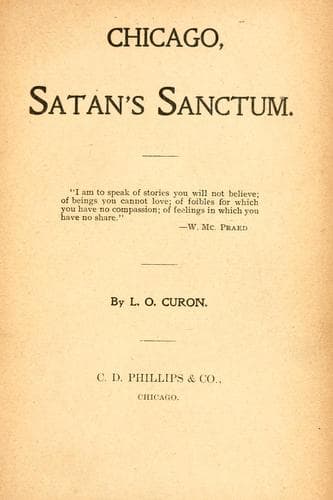
Crime -- Illinois -- Chicago; Police corruption -- Illinois -- Chicago; Political corruption -- Illinois -- Chicago
It cannot, however, be said that during his first administration he did
his whole duty. It is a peculiarity of the American people that they
always praise, with exaggeration, an official who partly does his duty, if
the part performed is regarded by them as especially serviceable to the
public. He had the benefit of so much exaggerated praise from a press
that, for nearly two years then last past, had been condemning him, that
some people were charmed into a sort of hysterical admiration for him. He
had the happy faculty of concealing the shortcomings of his first
administration, under cover of a supposedly overshadowing danger. Thereby
he caused his previous record to appear as if free from blemish, and that
he had performed every duty--and performed it well. The very adroit use of
this faculty is the only reason why he received a plurality of votes so
much larger than that of any other candidate nominated on the same ticket
with him for a minor office.
His best friends did not contend that he did his full duty. They now only
hope he will do so. A public official is not entitled to praise, or
thanks, for doing his whole duty. He is elected for the purpose of its
performance. But full performance is so rare that the people seem to be
content if a public servant will do his duty only fairly well.
The vices which prevail in the city, and which grew to their enormous,
threatening, and hideous proportions during the Mayor's first
administration, were known to the people to exist, but were forgotten by
them at the polls, were known to the police, and are still known to them,
and upon no conceivable basis of belief can it be supposed their existence
may not have been known to him, and that he does not know of their
continued existence.
It is for him to utter the command "Stop," and they will cease, in so far
as they can be kept within bounds by his authority. Their absolute
suppression, under existing legislation is, perhaps, impossible, but their
regulation thereunder is not wholly impracticable. Ordinances demanding,
for instance, the imposition of a fine of $200 per day for keeping a house
of ill fame, have, he may say, never been enforced, and have fallen into a
condition of "innocuous desuetude."
The field of observation on matters such as these is too wide to be
entered upon here.
During the Mayor's first term, one of his best friends, in the columns of
his widely circulated newspaper, severely criticised his administration,
but supported him for re-election, and explained in its columns, in
response to an inquiry made by a correspondent just prior to the election,
his reasons for doing so as follows, viz.:
Public-domain text, read in full here on John Shaqi.
Reviews
Reviews
No reviews yet
Be the first to share your thoughts on this work.
Join the Discussion
Join the discussion
Sign in to leave a comment or review.
Sign InorCreate an account