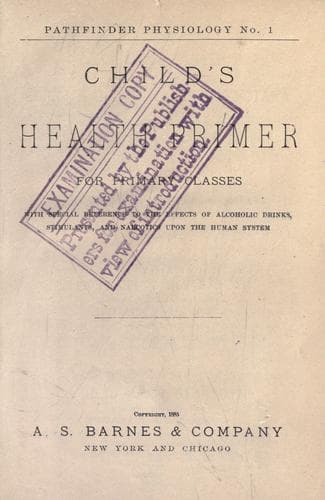
Child's Health Primer For Primary Classes: With Special Reference to the Effects of Alcoholic Drinks, Stimulants, and Narcotics upon The Human SystemAndrews, Jane
General
Child's Health Primer For Primary Classes: With Special Reference to the Effects of Alcoholic Drinks, Stimulants, and Narcotics upon The Human System
Andrews, Jane
Hygiene -- Juvenile literature; Physiology -- Juvenile literature
The doctor feels your pulse when you are sick, to find out whether the
heart is working too fast, or too slowly, or just right.
Some way is needed to send the gray fluid that is made from the food we
eat and drink, to every part of the body.
To send the food with the blood is a sure way of making it reach every
part.
So, when the stomach has prepared the food, the blood takes it up and
carries it to every part of the body. It then leaves with each part,
just what it needs.
THE BLOOD AND THE BRAIN.
As the brain has so much work to attend to, it must have very pure, good
blood sent to it, to keep it strong. Good blood is made from good food.
It can not be good if it has been poisoned with alcohol or tobacco.
We must also remember that the brain needs a great deal of blood. If we
take alcohol into our blood, much of it goes to the brain. There it
affects the nerves, and makes a man lose control over his actions.
EXERCISE.
When you run, you can feel your heart beating. It gets an instant of
rest between the beats.
Good exercise in the fresh air makes the heart work well and warms the
body better than a fire could do.
DOES ALCOHOL DO ANY HARM TO THE HEART?
Your heart is made of muscle. You know what harm alcohol does to the
muscles.
Could a fatty heart work as well as a muscular heart? No more than a
fatty arm could do the work of a muscular arm. Besides, alcohol makes
the heart beat too fast, and so it gets too tired.
REVIEW QUESTIONS.
1. Where is the heart placed?
2. Of what is it made?
3. What work does it do?
4. What are arteries and veins?
5. What does the pulse tell us?
6. How does the food we eat reach all parts of the
body?
7. How does alcohol in the blood affect the brain?
8. When does the heart rest?
9. How does exercise in the fresh air help the
heart?
10. What harm does alcohol do to the heart?
CHAPTER XV.
THE LUNGS.
[Illustration: T]HE blood flows all through the body, carrying good food
to every part. It also gathers up from every part the worn-out matter
that can no longer be used. By the time it is ready to be sent back by
the veins, the blood is no longer pure and red. It is dull and bluish in
color, because it is full of impurities.
If you look at the veins in your wrist, you will see that they look
blue.
If all this bad blood goes back to the heart, will the heart have to
pump out bad blood next time? No, for the heart has neighbors very near
at hand, ready to change the bad blood to pure, red blood again.
THE LUNGS.
These neighbors are the lungs. They are in the chest on each side of
the heart. When you breathe, their little air-cells swell out, or
expand, to take in the air. Then they contract again, and the air passes
out through your mouth or nose. The lungs must have plenty of fresh air,
and plenty of room to work in.
Public-domain text, read in full here on John Shaqi.
Reviews
Reviews
No reviews yet
Be the first to share your thoughts on this work.
Join the Discussion
Join the discussion
Sign in to leave a comment or review.
Sign InorCreate an account