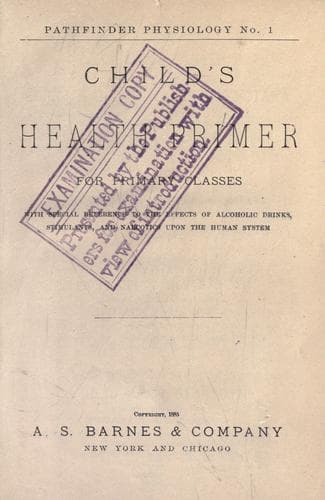
Child's Health Primer For Primary Classes: With Special Reference to the Effects of Alcoholic Drinks, Stimulants, and Narcotics upon The Human System — John Shaqi
Child's Health Primer For Primary Classes: With Special Reference to the Effects of Alcoholic Drinks, Stimulants, and Narcotics upon The Human SystemAndrews, Jane
General
Child's Health Primer For Primary Classes: With Special Reference to the Effects of Alcoholic Drinks, Stimulants, and Narcotics upon The Human System
Andrews, Jane
Hygiene -- Juvenile literature; Physiology -- Juvenile literature
If the thinking part of the brain does not have good quiet sleep, it
will soon wear out. A worn-out brain is not easy to repair.
If well cared for, your brain will do the best of work for you for
seventy or eighty years without complaining.
The nerves are easily tired out, and they need much rest. They get tired
if we do one thing too long at a time; they are rested by a change of
work.
IS ALCOHOL GOOD FOR THE NERVES AND THE BRAIN?
Think of the wonderful work the brain is all the time doing for you!
You ought to give it the best of food to keep it in good working order.
Any drink that contains alcohol is not a food to make one strong; but is
a poison to hurt, and at last to kill.
It injures the brain and nerves so that they can not work well, and send
their messages properly. That is why the drunkard does not know what he
is about.
Newspapers often tell us about people setting houses on fire; about men
who forgot to turn the switch, and so wrecked a railroad train; about
men who lay down on the railroad track and were run over by the cars.
Often these stories end with: "The person had been drinking." When the
nerves are put to sleep by alcohol, people become careless and do not do
their work faithfully; sometimes, they can not even tell the difference
between a railroad track and a place of safety. The brain receives no
message, or the wrong one, and the person does not know what he is
doing.
You may say that all men who drink liquor do not do such terrible
things.
That is true. A little alcohol is not so bad as a great deal. But even a
little makes the head ache, and hurts the brain and nerves.
A body kept pure and strong is of great service to its owner. There are
people who are not drunkards, but who often drink a little liquor. By
this means, they slowly poison their bodies.
When sickness comes upon them, they are less able to bear it, and less
likely to get well again, than those who have never injured their bodies
with alcohol.
When a sick or wounded man is brought into the hospital, one of the
first questions asked him by the doctor is: "Do you drink?"
If he answers "Yes!" the next questions are, "What do you drink?" and
"How much?"
The answers he gives to these questions, show the doctor what chance the
man has of getting well.
A man who never drinks liquor will get well, where a drinking man would
surely die.
TOBACCO AND THE NERVES.
Why does any one wish to use tobacco?
Because many men say that it helps them, and makes them feel better.
Shall I tell you how it makes them feel better?
If a man is cold, the tobacco deadens his nerves so that he does not
feel the cold and does not take pains to make himself warmer.
If a man is tired, or in trouble, tobacco will not really rest him or
help him out of his trouble.
It only puts his nerves to sleep and helps him think that he is not
tired, and that he does not need to overcome his troubles.
Public-domain text, read in full here on John Shaqi.
Reviews
Reviews
No reviews yet
Be the first to share your thoughts on this work.
Join the Discussion
Join the discussion
Sign in to leave a comment or review.
Sign InorCreate an account