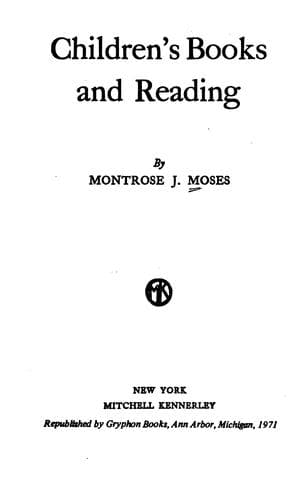
Children -- Books and reading; Children's literature -- Bibliography; Children's literature -- History and criticism
MARIA HACK. 1778–1844. Quaker parentage. A believer in the “walk”
species of literature. Author: Winter Evenings, or Tales of
Travellers; First Lessons in English Grammar; Harry Beaufoy, or the
Pupil of Nature. Reference: D. N. B.
MRS. ELIZABETH PENROSE. 1780–1837. Pseud. Mrs. Markham. Daughter of
a rector. One critic wrote: “Mrs. Penrose adapted her history to
what she considered the needs of the young, and omitted scenes of
cruelty and fraud, as hurtful to children, and party politics after
the Revolution as too complicated for them to learn.” Author: Began
school histories in 1823; these were brought up to date afterward
by Mary Howitt. Moral Tales and Sermons for Children. Reference: D.
N. B.
JOHN WILSON CROKER. 1780–1857. One of the founders of the _Quarterly
Review_; reviewed abusively Keats’s Endymion. Author: Stories from
the History of England, 1817, which supplied Scott with the idea
for his Tales of a Grandfather; Irish Tales. Reference: Jenning’s
Diaries and Correspondence of Croker (London, 1884); Internat.
Encyclo.
LADY MARIA CALLCOTT. 1785–1842. Author: Little Arthur’s History of
England. Reference: D. N. B.
MARY RUSSELL MITFORD. 1787–1855. Careful detail of description, akin
to Dutch style of painting. Author: Tragedies; Village Stories;
Juvenile Spectator. She was among the first women to adopt writing
as a profession. Miss Yonge speaks of her “writing so deliciously
of children,” but she “could not write for them.” Reference: D. N.
B.; Recollections; Letters.
AGNES STRICKLAND. 1796–1874. “With the exception of Jane Porter, whom
she visited at Bristol, and with whom she carried on a frequent
correspondence, and a casual meeting with Macaulay, whom she found
congenial, she came little in contact with the authors of the day.”
Author: Lives of the Queens of England; Two Rival Crusoes. [Note
the hybrid type of story that sprung up around the real Robinson
Crusoe.] Edited Fisher’s Juvenile Scrap Book, 1837–1839. Reference:
D. N. B.
MRS. MAY SEWELL. 1797–1884. Left Society of Friends for the Church
of England. Wrote homely ballads. _Vide_ daughter, Anna Sewell.
Author: Her ballad, Mother’s Last Words, circulated about 1,088,000
copies when it first appeared. Reference: Mod. Biog.
MARY HOWITT. 1799–1888. Authorship linked with that of her husband. In
1837 began writing children’s stories and poems. Her daughter, Anna
Mary, also was a writer of children’s books. Author: Translator of
Fredrika Bremer’s novels; editor, Fisher’s Drawingroom Scrap Book.
Reference: Reminiscences of My Later Life (_Good Words_, 1886); D.
N. B.
Public-domain text, read in full here on John Shaqi.
Reviews
Reviews
No reviews yet
Be the first to share your thoughts on this work.
Elsewhere in the archive
Join the Discussion
Join the discussion
Sign in to leave a comment or review.
Sign InorCreate an account