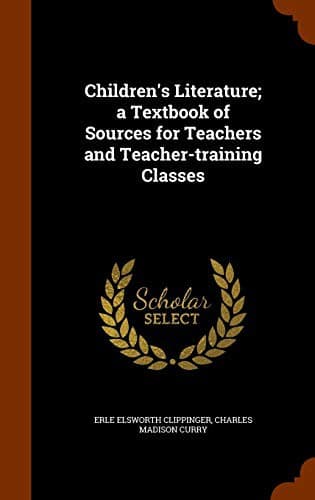
Children's Literature: A Textbook of Sources for Teachers and Teacher-Training ClassesCurry, Charles Madison
General
Children's Literature: A Textbook of Sources for Teachers and Teacher-Training Classes
Curry, Charles Madison
Children -- Books and reading; Children's literature -- Study and teaching
_Some qualities of these modern tales._ Every age produces after its own
fashion, and we must expect to find the modern user of the fairy-story
method expressing through it the qualities of his own outlook upon the
world. Interest in the picturesque aspects of landscape will be
emphasized, as in the early portions of "The Story of Fairyfoot" and,
with especial magnificence of style, throughout _The King of the Golden
River_. There will appear the saddened mood of the modern in the face of
the human miseries that make happiness a mockery, as in "The Happy
Prince." The destructive effects of the possessive instinct upon all
that is finest in human nature is reflected in "The Prince's Dream."
That the most valuable efforts are often those performed with least
spectacular settings may be discerned in "The Knights of the Silver
Shield," while the lesson of kindly helpfulness is the burden of "Old
Pipes and the Dryad." In many modern stories the reader is too much
aware of the conscious efforts of style and structure. The thoughtful
child will sometimes be too much distressed by the more somber modern
story, and should not hear too many of the gloomy type.
_Andersen the consummate master._ Hans Christian Andersen is the
acknowledged master of the modern story for children. What are the
sources of his success? Genius is always unexplainable except in terms
of itself, but some things are clear. To begin, he makes a mark--drives
down a peg: "There came a soldier marching along the high road--_one,
two! one, two!_" and you are off. No backing and filling, no jockeying
for position, no elaborate setting of the stage. The story's the thing!
Next, the language is the language of common oral speech, free and
unrestrained. The rigid forms of the grammar are eschewed. There is no
beating around the bush. Seeing through the eyes of the child, he uses
the language that is natural to such sight: "Aha! there sat the dog with
eyes as big as mill-wheels." In quick dramatic fashion the story unrolls
before your vision: "So the soldier cut the witch's head off. There she
lay!" No agonizing over the cruelty of it, the lack of sympathy. It is a
joke after the child's own heart, and with a hearty laugh at this end to
an impostor, the listener is on with the story. The logic is the logic
of childhood: "And everyone could see she was a real princess, for she
was so lovely." When Andersen deals with some of the deeper truths of
existence, as in "The Nightingale" or "The Ugly Duckling," he still
manages to throw it all into the form that is natural and convincing and
simple to the child. He never mounts a pedestal and becomes a grown-up
philosopher. Perhaps Andersen's secret lay in the fact that some fairy
godmother invested him at birth with a power to see things so completely
as a child sees them that he never questioned the dignity of the method.
In few of his stories is there any evidence of a constraint due to a
Public-domain text, read in full here on John Shaqi.
Reviews
Reviews
No reviews yet
Be the first to share your thoughts on this work.
Elsewhere in the archive
Join the Discussion
Join the discussion
Sign in to leave a comment or review.
Sign InorCreate an account