Wu Ting Fang, a Cantonese trained at Hongkong, London and Washington,
blossomed out suddenly at Shanghai in November, 1911, as foreign
minister of the provisional Chinese republican government of the
fourteen central, eastern and southern rebel provinces. The western
world stopped its breath in tremendous astonishment. Wu! the brilliant,
fashionable and evasive Chinese minister at Washington, who would
put you off on politics to discuss vegetarianism, a rebel! He was
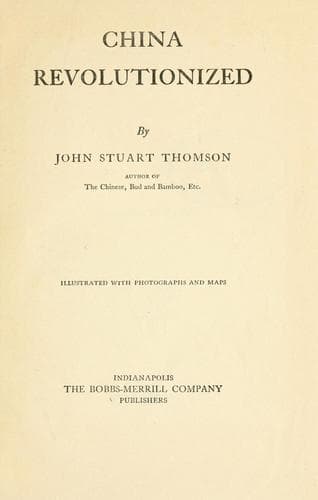
secretive beyond parallel, and had never talked revolution. The writer
tried to get him to talk reform in 1909 in connection with the reform
prophecies in his book, _The Chinese_, and though Wu had then fully
decided on the part he would take in the coming revolution, he would
only repeat what the writer said, and would express absolutely no
opinion of his own. I have known writers who have flayed him for this
abrupt evasion, calling him a “rice Christian” of yore, a temporizer,
etc., but I admire him for his calmness, fixed resolves, and patience
in waiting for the prodigious hour to strike. Wu knew what was coming,
and was heartily, though secretly, in favor of it. He was the first of
the rebels to insist on foreign acknowledgment of the rebel government,
and he formulated the most brilliant move of the revolution--the
announcement that if foreigners advanced money to the imperialists, and
the republicans won, the latter would repudiate such loans. This really
won the revolution, for numbers of the foreign syndicates, especially
the Russian, were at first heartily in favor of the Manchu _status
quo_. Wu has already codified the reform and penal laws of China, and
is prepared to enter upon that difficult question, extraterritoriality.
Watch Wu; he is not afraid to take the side of “China for the Chinese”,
although he is the most polished in western culture of all Chinese
officials. He aims to interpret the East to the West. Wu risked vast
preferment, and therefore he is a more sincere man than doughty Yuan,
and he will grow in power with the masses of the Chinese nation. His
brother-in-law is the exceedingly able Doctor Ho Kai, Commander of the
Order of Michael and George, the Chinese member of the Legislative
Council of the royal colony of Hongkong Island, a thorough legislator,
a lovable and brilliant man. Wu is a member of a worthy Canton family.
He is a graduate of the Middle Temple, London; has practised before
the Hongkong bar; and he served Li Hung Chang for many years as legal
adviser at Tientsin and Peking, in drawing up foreign treaties, etc.
Public-domain text, read in full here on John Shaqi.
Reviews
Reviews
No reviews yet
Be the first to share your thoughts on this work.
Join the Discussion
Join the discussion
Sign in to leave a comment or review.
Sign InorCreate an account