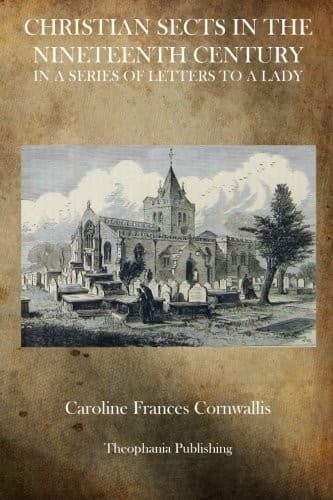
Christian Sects in the Nineteenth CenturyCornwallis, Caroline Frances
Religion
Christian Sects in the Nineteenth Century
Cornwallis, Caroline Frances
Christian sects -- History -- 19th century
“Christianity,” says an excellent prelate of our church, “forbids no
necessary occupation, no reasonable indulgences, no innocent relaxation.
It allows us to ‘use’ the world, provided we do not ‘abuse’ it. It does
not spread before us a delicious banquet, and then come with a ‘Touch
not, taste not, handle not:’ all it requires is that our liberty
degenerate not into licentiousness; our amusements into dissipation; our
industry into incessant toil; our carefulness into extreme anxiety and
endless solicitude. When it requires us to be ‘temperate in all things,’
it plainly tells us that we _may_ use all things temperately. {26} When
it directs us to ‘make our moderation known unto all men,’ this evidently
implies that within the bounds of moderation we may enjoy all the
reasonable conveniences and comforts of this present life.”
I have noticed this, in my opinion, erroneous practice of the Quakers at
the more length, because it is not confined to them. Asceticism, of
which this is one branch, has been the bane of the church and of
Christianity generally; and few sects are entirely free from the notion
that holiness requires a withdrawal from amusements, and a certain degree
of seclusion from the world. Yet, if the world is to be improved, the
leaven must be placed _in_ it; and a good man probably never does his
Father’s work more effectually than when he spreads the sanctifying
influence of his example through all the relations of life; showing that
there is no position in society where Christianity does not add a grace
and a relish unknown without it: spreading refinement of manners and
delicacy of thought, and insensibly rendering social intercourse more
polished, and more delightful, by banishing from it all that can offend.
The Quakers adduce Matt. v. 33–37, James v. 12, &c. in support of their
objection to all oaths, even judicial ones, and consider that the
Christian dispensation abrogated their use. But in answer to this we may
observe that even the Almighty is represented as confirming his promises
by a solemn oath. “Because,” says the apostle, “He could swear by no
higher, He sware by Himself;” and St. Paul on particular occasions
expresses himself thus, “As God is true:” “Before God I lie not:” “God is
my record,” &c. all which expressions undoubtedly contain the essence and
formality of an oath; and the Apostle upon some occasions mentions this
solemn swearing with approbation, “an oath for confirmation is the end of
all strife:” the swearing, therefore, which our Saviour absolutely
forbids, is common or unnecessary swearing, and we are recommended to
affirm or deny in common conversation without imprecations. “Let your
conversation be yea, yea,—nay, nay.”
Public-domain text, read in full here on John Shaqi.
Reviews
Reviews
No reviews yet
Be the first to share your thoughts on this work.
Join the Discussion
Join the discussion
Sign in to leave a comment or review.
Sign InorCreate an account