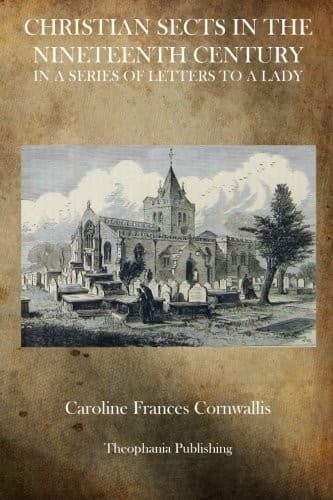
Christian Sects in the Nineteenth CenturyCornwallis, Caroline Frances
Religion
Christian Sects in the Nineteenth Century
Cornwallis, Caroline Frances
Christian sects -- History -- 19th century
It may be added, that their strict abstinence from the common amusements
of the world, even where innocent in themselves, has its evils, as I have
already noticed when speaking of the Quakers; for the mind cannot always
be kept in a state of tension, and if we refuse ourselves recreation
altogether, there is danger that we shall find the yoke of Christ a
wearisome instead of an easy one, and cast it off in disgust; nay, I am
afraid that if we were to inquire closely, we should find instances
enough of this result to demonstrate, what indeed wants but little proof,
i.e. that God knows better than we do “whereof we are made,” and that it
is not wisdom to bind a heavy burthen on our shoulders when Christ
himself has declared that his is light. Still, though tinged with a
degree of enthusiasm which we may regret, the doctrine of the Wesleyan
Methodists retains the fundamental parts of Christianity, and after
reading the following extracts from Wesley’s Sermons, I think you will
hardly forbear asking, Why is this a separate sect?
“Justifying Faith implies not only a Divine ελεγχος, evidence or
conviction, that ‘God was in Christ reconciling the world to himself,’
but a sure trust and confidence that Christ died for _my_ sins, that he
loved _me_, and gave himself for me; and the moment a penitent sinner
believes this, God pardons and absolves him.” {64a} “Christian
perfection does not imply, as some men seem to have imagined, an
exemption either from ignorance, or mistake, or infirmities, or
temptations; indeed it is only another term for holiness: thus every one
that is holy, is in the Scripture sense ‘perfect.’ We may yet observe
that neither in this respect is there absolute perfection on earth.”
{64b} “If the Scriptures are true, those who are holy or religious in
the judgment of God himself, those who are endued with the faith that
purifies the heart, that produces a good conscience; those who live by
faith in the Son of God; those who are sanctified by the blood of the
Covenant may nevertheless so fall from God as to perish everlastingly,
therefore let him who thinketh he standeth take heed lest he fall.” “In
strictness neither our faith nor our works justify us, i.e. _deserve_ the
remission of our sins, but God himself justifies us of his own mercy
through the merits of his Son only.” {65}
[Picture: Decorative header]
LETTER V.
GENERAL BAPTISTS, MORAVIANS, SWEDENBORGIANS, PLYMOUTH BRETHREN.
Public-domain text, read in full here on John Shaqi.
Reviews
Reviews
No reviews yet
Be the first to share your thoughts on this work.
Join the Discussion
Join the discussion
Sign in to leave a comment or review.
Sign InorCreate an account