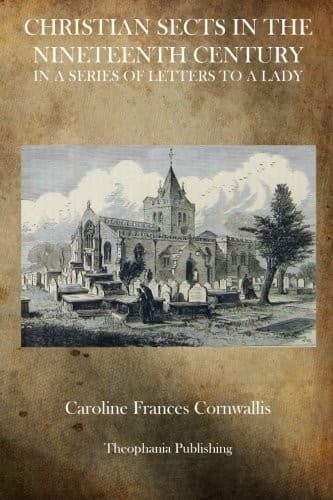
Christian Sects in the Nineteenth CenturyCornwallis, Caroline Frances
Religion
Christian Sects in the Nineteenth Century
Cornwallis, Caroline Frances
Christian sects -- History -- 19th century
The MORAVIANS are supposed to have derived their origin from Nicholas
Lewis, Count Zinzendorf, a German nobleman, who died in 1760. The
society however assert that they are descended from the old Moravian and
Bohemian Brethren, who existed as a distinct sect sixty years prior to
the Reformation. No sooner had these Moravian Brethren heard of Luther’s
bold testimony to the truth, and of the success which attended his
labours, than they sent in the year 1522 two deputies to assure him of
“the deep interest which they took in his work;” giving him, at the same
time, an account of their own doctrine and constitution. They were most
kindly received; and both Luther, and his colleague Bucer, recognised the
Moravians as holding the same faith; and bore honourable testimony to the
purity of their doctrine, and the excellence of their discipline. The
chief doctrine of the Moravian society is, that “by the sacrifice for sin
made by Jesus Christ, and by that alone, grace and deliverance from sin
are to be obtained for all mankind:” and they stedfastly maintain the
following points:
1. The divinity of Christ.
2. The atonement and satisfaction made for us by Jesus Christ; and that
by his merits alone we receive freely the forgiveness of sin, and
sanctification in soul and body.
3. The doctrine of the Holy Spirit, and the operations of his grace.
That it is he who worketh in us conviction of sin, faith in Christ, and
pureness of heart.
4. That faith must evidence itself by willing obedience to the
commandments of God from love and gratitude.
The internal constitution of the ancient church of the Moravians, which
is still substantially adhered to, was originally adopted in 1457, and
more definitely settled in 1616 by the Synod of Zerawitz. Its principal
peculiarities are,
1. Every church is divided into three classes, i.e. 1. _Beginners_ or
_Catechumens_. 2. _The more advanced_ or _communicants_, who are
considered as members of the church. 3. _The perfect_, consisting of
such as have persevered for some time in a course of true piety. From
this last class are chosen in every church _the Elders_, from three to
eight in number.
2. Every congregation is directed by a board of elders, whose province
it is to have a watchful eye over its members with respect to the
doctrine and deportment. Once in three months these elders are bound to
visit the houses of the brethren, in order to observe their conduct, and
to ascertain whether every one is labouring diligently in his calling,
&c. of which they make a report to the pastor. They also are required to
visit the sick, and assist the poorer brethren with money, contributed by
the members of the church, and deposited in an alms box.
Public-domain text, read in full here on John Shaqi.
Reviews
Reviews
No reviews yet
Be the first to share your thoughts on this work.
Join the Discussion
Join the discussion
Sign in to leave a comment or review.
Sign InorCreate an account