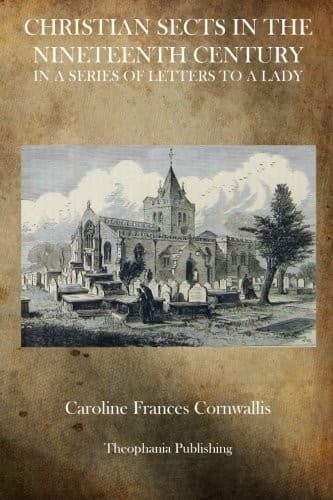
Christian Sects in the Nineteenth CenturyCornwallis, Caroline Frances
Religion
Christian Sects in the Nineteenth Century
Cornwallis, Caroline Frances
Christian sects -- History -- 19th century
His writings are so very obscure, that it is difficult to state what are
the opinions contained in them; he taught, however, that by the New
Jerusalem which came down from heaven, was intended a new church as to
doctrine, and that he was the person to whom this doctrine was revealed,
and who was appointed to make it known to the world. Swedenborg made no
attempt to found a sect; but after his death, his followers, in 1788,
formed themselves into a society under the denomination of “The New
Jerusalem Church.” They have several places of meeting, both in London
and Manchester, and send delegates to a “General Conference,” under whose
direction a liturgy has been prepared, from which I shall make a few
extracts to shew the peculiar doctrines of this sect.
The following are some of the questions asked of the candidate for
ordination, which is performed by imposition of hands, of course of a
minister of their own communion.
“_Min._ Dost thou believe that Jehovah God is One both in Essence and in
Person; in whom, nevertheless, is the Divine Trinity of Father, Son, and
Holy Spirit; and that these are, his Essential Divinity, his Divine
Humanity, and his Divine Proceeding, which are the three Essentials of
One God, answering to the soul, the body, and the operative energy, in
man, and that the Lord and Saviour Jesus Christ is that God?
Dost thou believe that by his temptations, the last of which was the
passion of the cross, the Lord united, in his Humanity, Divine Truth to
Divine Good, or Divine Wisdom to Divine Love, and so returned into his
Divinity in which he was from eternity, together with, and in, his
Glorified Humanity?
Dost thou believe that the sacred Scripture, or Word of God, is Divine
Truth itself, and that it contains a spiritual and celestial sense,
heretofore unknown, whence it is divinely inspired and holy in every
syllable; as well as a literal sense, which is the basis and support of
its spiritual and celestial sense?
Dost thou believe that the books which have the internal sense and are
truly the Word of God are,—the five books of Moses, Joshua, Judges, the
two books of Samuel, the two books of Kings, the Psalms of David, the
prophets, including the Lamentations of Jeremiah, the four Gospels, and
the Revelation?” {79}
It is further stated in their eleventh article of faith, “That
immediately after death, which is only a putting off of the material
body, never to be resumed, man rises again in a spiritual or substantial
body, in which he continues to live to eternity.”
Public-domain text, read in full here on John Shaqi.
Reviews
Reviews
No reviews yet
Be the first to share your thoughts on this work.
Join the Discussion
Join the discussion
Sign in to leave a comment or review.
Sign InorCreate an account