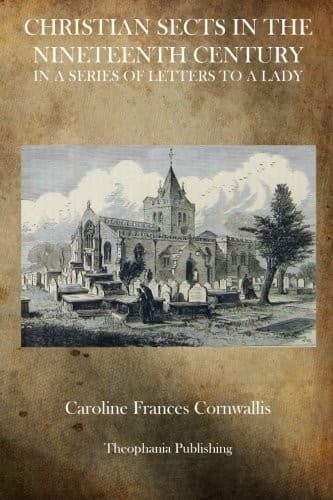
Christian Sects in the Nineteenth Century — John Shaqi
Christian Sects in the Nineteenth CenturyCornwallis, Caroline Frances
Religion
Christian Sects in the Nineteenth Century
Cornwallis, Caroline Frances
Christian sects -- History -- 19th century
Marriage is regarded by the Quakers as a religious, not a mere civil
compact. Those who wish to enter into that state appear together, and
state their intentions at one of the monthly meetings, and if not
attended by parents or guardians must produce their consent in writing
duly witnessed; and if no objections are raised at a subsequent meeting,
they are allowed to solemnize their marriage, which is done at a public
meeting for worship; towards the close of which the parties stand up and
solemnly take each other for man and wife. A certificate of the
proceedings is then read publicly and signed by the parties, and
afterwards by the relations as witnesses. The monthly meeting keeps a
register of the marriages as well as of the births and burials of the
society.
Children are named without any attending ceremony; neither is it held
_needful_ that there should be any at burial, though the body followed by
the relatives and friends is sometimes carried into a meeting house, and
at the grave a pause is generally made to allow of a discourse from any
friend attending if he be so inclined.
The women have monthly, quarterly, and yearly meetings of their own sex,
but without the power of making rules. “As we believe,” they say, “that
women may be rightly called to the work of the ministry, we also think
that to them belongs a share in the support of Christian discipline; and
that some parts of it wherein their own sex is concerned devolve on them
with peculiar propriety.”
But what, you will ask, are the religious tenets of this sect? The
question will perhaps best be answered by an extract from their “Rules of
Discipline,” a work published under the sanction of the society. “The
original and immediate ground of the religious fellowship of the early
Friends,” says the writer of this manual, “was _union of sentiment in
regard to Christ’s inward teaching_.” They were firm believers in all
that is revealed in Holy Scripture respecting our Lord and Saviour Jesus
Christ; nor would they have allowed that any one held the truth who
denied his coming in the flesh, or the benefit to fallen man by his
propitiatory sacrifice. “We believe that, in order to enable mankind to
put in practice the precepts of the gospel, every man coming into the
world is endued with a measure of the light, grace, or good Spirit of
Christ, by which, as it is alluded to, he is enabled to distinguish good
from evil, and to correct the disorderly passions and corrupt
propensities of his fallen nature, which _mere reason_ is altogether
insufficient to overcome. For all that belongs to man is fallible, and
within the reach of temptation: but the divine grace, which comes by Him,
i.e. Christ, who hath overcome the world, is, to those who humbly and
sincerely seek it, an all-sufficient and present help in time of need . . .
whereby the soul is translated out of the kingdom of darkness, and from
under the power of Satan into the marvellous light and kingdom of the Son
of God.
Public-domain text, read in full here on John Shaqi.
Reviews
Reviews
No reviews yet
Be the first to share your thoughts on this work.
Join the Discussion
Join the discussion
Sign in to leave a comment or review.
Sign InorCreate an account