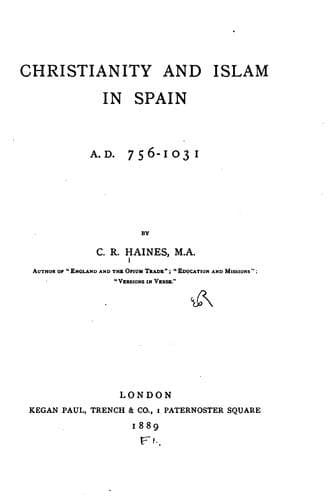
Christianity and Islam in Spain, A.D. 756-1031Haines, Charles Reginald
Islamic
Christianity and Islam in Spain, A.D. 756-1031
Haines, Charles Reginald
Christian martyrs -- Spain; Christianity -- Spain; Islam -- Spain
Of the relations of Claudius to the Saracens we have the direct
statement of one of his opponents, who said that the Jews praised him,
and called him the wisest among the Christians; and that he on his side
highly commended them _and the Saracens_.[4] Yet his tendency seems to
have been against the Judaizing of the Church.[5]
[1] Fifty years later Alvar ("Ind. Lum.," sec. 9), accuses
certain Christians of dissembling their religion under fear of
persecution:--"Deum Christum non aperte coram eis (_i.e._
Saracenis) sed fugatis sermonibus proferunt, Verbum Dei et
Spiritum, ut illi asserunt, profitentes, suasque confessiones
corde, quasi Deo omnia inspiciente, servantes."
[2] Jonas of Orleans (Migne, cvi. p. 330) calls him so, and
says elsewhere, "Felix resuscitur in Claudio."
[3] Neander, vi. 119.
[4] Fleury, v. 398.
[5] Neander, vi. 125.
The great Iconoclastic reform, which arose in the East, undoubtedly
received its originating impulse from the Moslems. In 719 the Khalif
destroyed all images in Syria. His example was followed in 730 by the
Eastern Emperor, Leo the Isaurian. He is said to have been persuaded to
this measure by a man named Bezer, who had been some years in captivity
among the Saracens.[1] In 754 the great council of Constantinople
condemned images. Unfortunately neither the great patriarchates nor the
Pope were represented, and so this council never obtained-the sanction
of all Christendom; and its decrees were reversed in 787 at the Council
of Nicæa. In 790 appeared the Libri Carolini, in which we rejoice to
find our English Alcuin helping Charles the Great to make a powerful and
reasonable protest against the worship of images.[2] In 794 this protest
was upheld by the German Council of Frankfurt. But the Pope, and his
militia,[3] the monks, made a strenuous opposition to any reform in this
quarter, and the recognition of images became part and parcel of Roman
Catholic Christianity.
Claudius was made bishop of Turin in 828.[4] Though placed over an
Italian diocese, he soon shewed the independence, which he had imbibed
in the free air of Spain, where the Mohammedan supremacy had at least
the advantage of making the supremacy of the Pope impossible. Finding
that the people of his diocese paid worship to their images, Claudius
set to work to deface, burn, and abolish, all images and crosses in his
bishopric. In respect to the crosses he went further than other
Iconoclasts, in which we can perhaps trace his Adoptionist training.[5]
These new views did not, as might be expected, find favour with the
Catholic party, whose cause was taken up by Theodemir, abbot of Nîmes, a
friend of Claudius', by Jonas of Orleans, and Dungal, an Irish priest.
But, as in the case of Felix, the heresiarch was more than a match for
his opponents in argument.[6]
[1] Fleury, xl. ii. 1, says he was an apostate. See Mendham,
Seventh General Council, Introd., pp. xii. xiv.
Public-domain text, read in full here on John Shaqi.
Reviews
Reviews
No reviews yet
Be the first to share your thoughts on this work.
Elsewhere in the archive
Join the Discussion
Join the discussion
Sign in to leave a comment or review.
Sign InorCreate an account