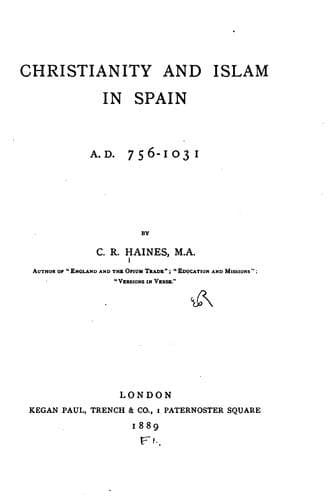
Christianity and Islam in Spain, A.D. 756-1031Haines, Charles Reginald
Islamic
Christianity and Islam in Spain, A.D. 756-1031
Haines, Charles Reginald
Christian martyrs -- Spain; Christianity -- Spain; Islam -- Spain
[7] No reliance can be placed in the statement of the
Pseudo-Luitprand, who, in a letter to Recemundus, speaking of
Elipandus, says: "Postquam illius erroris sui de adoptione
Christi sero et vere poenituit, ad quod manifestandum concilium
(795) episcoporum ... collegit; et coram omnibus abiurato
publice errore _fidem sanctae ecclesiae Romanae_ confessus
est." These words in italics reveal a later hand. Cp. also sec.
259 and Julianus. Alcuin, in a letter to Aquila, bishop of
Salisbury, says that Elipandus in 800 A.D. still adhered to his
error.
We have dealt somewhat at length with the Adoptionist heresy, both from
its interest and importance, and because, as mentioned above, there are
some reasons for thinking that it was the outcome of a wish to
conciliate Mohammedan opinion. It will be as well to recapitulate such
evidence as we have obtained on this point. But we must not expect to
find the traces of Mohammedan influence in the development, so much as
in the origination, of the theory. What we do find is slight enough,
amounting to no more than this:--
(_a._) That the one point, which repelled the Mohammedan from genuine
Christianity--setting aside for a moment the transcendental mystery of
the Trinity--was the Divinity of Christ. Anything, therefore, that
tended to emphasise the humanity of Jesus, or to obscure the great fact
of Christ the Man, being Son of God, which sounded so offensive to
Mohammedan ears, would so far bring the Christian creed nearer to the
Mohammedan's acceptance, by assimilating the Christian conception of
Christ, to that which appears so often in the Koran.[1] There can be no
doubt that the theory of adoption, if carried to its logical
conclusion, did contribute to this result:
(_b._) That Elipandus was accused of receiving the help of the secular
arm in disseminating his heretical opinions:
(_c._) That the application of the term _Servant_ to Christ, besides
being authorised by texts from Scripture, is countenanced in two
passages from the Koran:
(_d._) That Leo III., speaking of, Felix's return to Spain, and his
relapse into error, implies that it was due to his renewed contact with
infidels who held similar views:
(_e._) That in a passage, quoted by Enhueber, Elipandus is said to have
lost his hold on the truth in consequence of his close intercourse with
the Arabs:
(_f._) That Elipandus accused Etherius of being a false prophet, that
is, for giving, as has been conjectured, a Mohammedan interpretation to
the Beast in the Revelation of St John.
Something must now be said of one more doctrine, which, though it did
not arise in Spain, nor perhaps much affected it, yet was originated by
a Spaniard, and a disciple of Felix,[2]--Claudius, Bishop of Turin. Some
have seen in this doctrine, which was an offshoot of Iconoclasm, traces
of Adoptionism, a thing not unlikely in itself.[3]
Public-domain text, read in full here on John Shaqi.
Reviews
Reviews
No reviews yet
Be the first to share your thoughts on this work.
Elsewhere in the archive
Join the Discussion
Join the discussion
Sign in to leave a comment or review.
Sign InorCreate an account