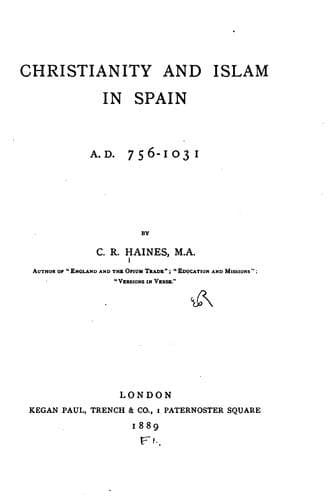
Christianity and Islam in Spain, A.D. 756-1031Haines, Charles Reginald
Islamic
Christianity and Islam in Spain, A.D. 756-1031
Haines, Charles Reginald
Christian martyrs -- Spain; Christianity -- Spain; Islam -- Spain
[4] See Appendix B, pp. 161-173.
[5] So Blunt. It found followers in Leon. See Mariana, xii. 2,
from Lucas of Tuy.
CHAPTER X.
SOCIAL INFLUENCE OF CHRISTIANITY.
Having considered the effects of Mohammedanism on doctrinal Christianity
(there are no traces of similar effects on doctrinal Mohammedanism), it
will fall within the scope of our inquiry to estimate the extent to
which those influences were reciprocally felt by the two religions in
their social and intellectual aspects; and how far the character of a
Christian or a Mohammedan was altered by contact with a people
professing a creed so like, and yet so unlike.[1] This influence we
shall find more strongly manifested in the action of Christianity on
Islam, than the reverse.
It is well known that Mohammed, though his opinion as to monks seems to
have varied[2] from time to time, is reported to have expressly declared
that he would have no monks in his religion.[3] Abubeker, his
successor,--if Gibbon's translation may be trusted,--in his marching
orders to the army, told them to let monks and their monasteries
alone.[4] It was not long, however, before an order of itinerant
monks--the faquirs--arose among the Moslems. In other parts of their
dominions these became a recognised, and in some ways privileged, class;
but in Andalusia they did not receive much encouragement,[5] though they
were very numerous even there. Most of them, says the Arabian
historian,[6] were nothing more than beggars, able but unwilling to
work. This remark, however, he tells us, must not be applied to all,
"for there were among them men who, moved by sentiments of piety and
devotion, left the world and its vanities, and either retired to
convents to pass the remainder of their days among brethren of the same
community, or putting on the darwázah, and grasping the faquir's staff,
went through the country begging a scanty pittance, and moving the
faithful to compassion by their wretched and revolting appearance." That
Moslem monkeries did exist, especially in rather later times, we can
gather from the above passage and from another place,[7] where a convent
called Zawiyatu l'Mahruk (the convent of the burnt) is mentioned. On
that passage De Gayangos[8] has an interesting note, in which he quotes
from an African writer an account of a monastic establishment near
Malaga.[9] The writer says: "I saw on a mountain, close to this city, a
convent, which was the residence of several religious men living in
community, and conversant with the principles of Sufism: they have a
superior to preside over them, and one or more servants to attend to
their wants. Their internal regulations are really admirable; each
faquir lives separately in a cell of his own, and meets his comrades
only at meals or prayers. Every morning at daybreak the servants of the
community go round to each faquir, and inquire of him what provisions he
wishes to have for his daily consumption.... They are served with two
meals a day.
Public-domain text, read in full here on John Shaqi.
Reviews
Reviews
No reviews yet
Be the first to share your thoughts on this work.
Elsewhere in the archive
Join the Discussion
Join the discussion
Sign in to leave a comment or review.
Sign InorCreate an account