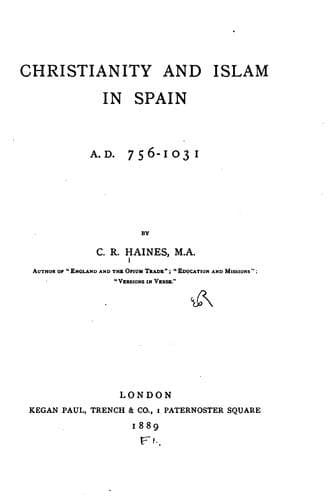
Christianity and Islam in Spain, A.D. 756-1031Haines, Charles Reginald
Islamic
Christianity and Islam in Spain, A.D. 756-1031
Haines, Charles Reginald
Christian martyrs -- Spain; Christianity -- Spain; Islam -- Spain
Their dress consists of a coarse woollen frock, two being
allowed yearly for each man--one for winter, another for summer. Each
faquir is furnished likewise with a regular allowance of sugar, soap to
wash his clothes, oil for his lamp, and a small sum of money to attend
the bath, all these articles being distributed to them every Friday....
Most of the faquirs are bachelors, a few only being married. These live
with their wives in a separate part of the building, but are subject to
the same rule, which consists in attending the five daily prayers,
sleeping at the convent, and meeting together in a lofty-vaulted
chamber, where they perform certain devotions.... In the morning each
faquir takes his Koran and reads the first chapter, and then that of
the king;[10] and when the reading is over, a Koran, previously divided
into sections, is brought in for each man to read in turn, until the
whole is completed. On Fridays and other-festivals these faquirs are
obliged to go to the mosque in a body, preceded by their superior....
They are often visited by guests, whom they entertain for a long time,
supplying them with food and other necessaries. The formalities observed
with them are as follows:--If a stranger present himself at the door of
the convent in the garb of a faquir, namely, with a girdle round his
waist, his kneeling-mat suspended between his shoulders, his staff in
his right hand, and his drinking vessel in his left, the porter of the
convent comes up to him immediately, and asks what country he comes
from, what convent he has resided in, or entered on the road, who was
the superior of it, and other particulars, to ascertain that the visitor
is not an impostor.... This convent was plentifully endowed with rents
for the support of its inmates, for besides the considerable revenue in
lands which was provided by its founder, a wealthy citizen of Malaga,
who had been governor of the city under the Almohades, pious men are
continually adding to the funds either by bequests in land or by
donations in money."
The resemblance between these faquirs and Christian monks is
sufficiently obvious, and need not be dilated upon: and though this
particular convent was established at a later time, we cannot doubt that
the influence, which produced such a modification of the very spirit of
Islam, must have made itself felt much earlier. This is apparent in the
analogous case of Moslem nuns, as a passage from an Arab writer seems to
shew,[11] where it is said that the body of the Moorish king, Gehwar
(1030-1043), was followed to the grave even by the damsels who had
retired into solitude.
[1] Mohammedanism is even called a _heresy_ by a writer quoted
by Prescott, "Ferdin. and Isab.," p. 244.
Public-domain text, read in full here on John Shaqi.
Reviews
Reviews
No reviews yet
Be the first to share your thoughts on this work.
Elsewhere in the archive
Join the Discussion
Join the discussion
Sign in to leave a comment or review.
Sign InorCreate an account