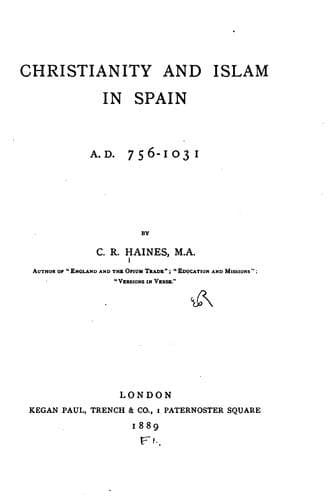
Christianity and Islam in Spain, A.D. 756-1031Haines, Charles Reginald
Islamic
Christianity and Islam in Spain, A.D. 756-1031
Haines, Charles Reginald
Christian martyrs -- Spain; Christianity -- Spain; Islam -- Spain
Prone as the Mohammedans were to superstition, and many as are the
miracles and wonders, which are described in their histories, it must be
acknowledged that their capacity for imagining and believing in
miracles never equalled that of Christian priests in the Middle Ages.[1]
We hear indeed of a vision of Mohammed appearing to Tarik, the invader
of Spain;[2] of a miraculous spring gushing forth at the prayer of Akbar
ibn Nafir;[3] of the marvellous cap of Omar;[4] of the wonders that
distinguished the corpse of the murdered Hosein; of the vision shewing
the tomb of Abu Ayub;[5] but nothing that will bear a comparison with
the invention of St James' body at Ira Flavia (Padron), nor the clumsy
and unblushing forgery of relics at Granada in the year of the
Armada.[6] Yet the following story of Baki ibn Mokhlid, from Al
Kusheyri,[7] reminds us forcibly of similar monkish extravagancies. A
woman came to Baki, and said that, her son being a prisoner in the hands
of the Franks, she intended to sell her house and go in search of him;
but before doing so she asked his advice. Leaving her for a moment he
requested her to wait for his answer. He then went out and prayed
fervently for her son's release, and telling the mother what he had
done, dismissed her. Some time after the mother came back with her son
to thank Baki for his pious interference, which had procured her son's
release. The son then told his story:--"I was the king's slave, and used
to go out daily with my brother slaves to certain works on which we were
employed. One day, as we were going I felt all of a sudden as if my
fetters were being knocked off. I looked down to my feet, when lo! I
saw the heavy irons fall down broken on each side." The inspector
naturally charged him with trying to escape, but he denied on oath,
saying that his fetters had fallen off without his knowing how. They
were then riveted on again with additional nails, but again fell off.
The youth goes on:--"The Christians then consulted their priests on the
miraculous occurrence, and one of them came to me and inquired whether I
had a father. I said 'No, but I have a mother.' Well, then, said the
priest to the Christians, 'God, no doubt, has listened to her prayers.
Set him at liberty,'" which was immediately done. As a set-off to this
there is a remarkable instance of freedom from superstition recorded of
King Almundhir(881-2).[8] On the occasion of an earthquake, the people
being greatly alarmed, and looking upon it as a direct interposition of
God, this enlightened prince did his best to convince them that such
things were natural phenomena, and had no relation to the good or evil
that men did,[9] shewing that the earth trembled for Christian and
Moslem alike, for the most innocent as well as the most injurious of
creatures without distinction. They, however, refused to be convinced.
Public-domain text, read in full here on John Shaqi.
Reviews
Reviews
No reviews yet
Be the first to share your thoughts on this work.
Elsewhere in the archive
Join the Discussion
Join the discussion
Sign in to leave a comment or review.
Sign InorCreate an account