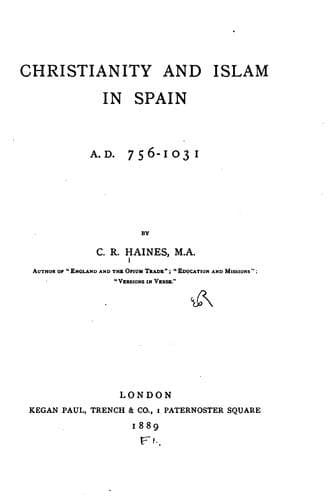
Christianity and Islam in Spain, A.D. 756-1031Haines, Charles Reginald
Islamic
Christianity and Islam in Spain, A.D. 756-1031
Haines, Charles Reginald
Christian martyrs -- Spain; Christianity -- Spain; Islam -- Spain
[1] See the story of Atahulphus, Bishop of Compostella, and the
bull--Alfonso of Burgos, ch. 66: a man swallowed up by the
earth--Mariana, viii. 4: Sancho the Great's arm withered and
restored--_Ibid._, c. 10: a Sabellian heretic carried off by
the devil in sight of a large congregation--Isidore of Beja,
sec. 69: the miracle of the roses (1050)--Mar. ix. 3.
[2] Cardonne, i. p. 72.
[3] _Ibid_, p. 38.
[4] See Ockley.
[5] Gibbon, "for such are the manufacture of every religion,"
p. 115.
[6] See Geddes, Miscell. Tracts, "an account of MSS. and relics
found at Granada." But we must remember that these miraculous
phenomena appear much earlier in the history of Islam than of
Christianity.
[7] Al Makkari, ii. 129; cp. Conde, i. 355.
[8] Conde, i. 317.
[9] Cp. Matt. v. 45: Luke xiii. 4.
This independence of thought in Almundhir was perhaps an outcome of that
philosophic spirit which first shewed itself in Spain in the reign of
this Sultan's predecessor.[1] The philosophizers were looked upon with
horror by the theologians, who worked upon the people, so that at times
they were ready to stone and burn the free-thinkers.[2] The works of
Ibnu Massara, a prominent member of this school, were burnt publicly at
Cordova;[3] and the great Almanzor, though himself, like the great
Caesar, indifferent to such questions,[4] by way of gaining the support
of the masses, was ready, or pretended to be ready, to execute one of
these philosophers. At length, with feigned reluctance, he granted the
man's life at the request of a learned faqui.[5]
Even among the Mohammedan "clergy"--if the term be allowable--there were
Sceptics and Deists,[6] and others who followed the wild speculations of
Greek philosophy. Among the last of these, the greatest name was
Averroes, or more correctly, Abu Walid ibn Roshd (1126-1198), who
besides holding peculiar views about the human soul that would almost
constitute him a Pantheist, taught that religion was not a branch of
knowledge that could be systematised, but an inward personal power:[7]
that science and religion could not be fused together. Owing to his
freedom of thought he was banished to a place near Cordova by Yusuf abu
Yakub in 1196. He was also persecuted and put into prison by Abdulmumen,
son of Almansur,[8] for studying natural philosophy. Another votary of
the same forbidden science, Ibn Habib, was put to death by the same
king.
[1] Dozy, iii. 18.
[2] Al Makk., i. 136, 141. They were called Zendik or heretics
by the pious Moslems. See also Said of Toledo, apud Dozy, iii.
109.
[3] Al Makk., ii. 121.
Public-domain text, read in full here on John Shaqi.
Reviews
Reviews
No reviews yet
Be the first to share your thoughts on this work.
Elsewhere in the archive
Join the Discussion
Join the discussion
Sign in to leave a comment or review.
Sign InorCreate an account