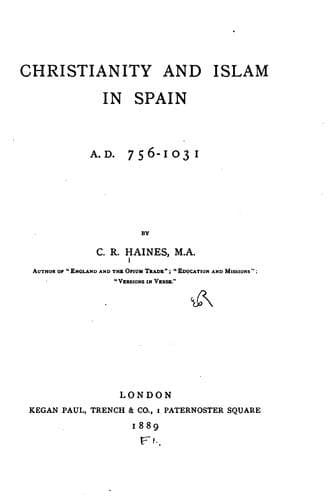
Christianity and Islam in Spain, A.D. 756-1031Haines, Charles Reginald
Islamic
Christianity and Islam in Spain, A.D. 756-1031
Haines, Charles Reginald
Christian martyrs -- Spain; Christianity -- Spain; Islam -- Spain
_(d.)_ The prohibition of sculptures, representing living creatures, was
disregarded. We find a statue, raised to Abdurrahman's wife Zahra, in
the Medinatu'l Zahra, a palace built by Abdurrahman III. in honour of
his beloved mistress. Images of animals are mentioned on the
fountains,[9] and a lion on the aqueduct.[10] We also hear of a statue
at the gate of Cordova.[11]
_(e.)_ The Spanish Arabs even seem to have given up turning towards
Mecca: for what else can we infer from a fact mentioned by an Arab
historian,[12] that Abu Obeydah was called Sahibu l'Kiblah as a
distinctive nickname, because he did so turn?
_(f.)_ A reformer seems even to have arisen, who wished to persuade his
coreligionists to eat the flesh of sows, though not of pigs or
boars.[13]
[1] Al Makkari, ii., App. 28. Author quoted by De Gayangos: The
Moslems in the eleventh century "began to drink wine and commit
all manner of excesses. The rulers of Andalus thought of
nothing else than purchasing singing-women and slaves,
listening to their music, and passing the time in revelry and
mirth."
[2] Kor. v. 93--"Surely wine, lots, and images are an
abomination of the work of Satan ... avoid them."
[3] Al Makkari, ii. p. 171.
[4] Cardonne, i. p. 252.
[5] Al Makkari, i. p. 108; ii. p. 171.
[6] Yonge, "Moors in Spain," p. 71.
[7] Sale, Koran, Introduc., p. 122. (Chandos Classics.)
[8] Al Makkari, ii. p. 109. In 678 Yezid, son of Muawiyah, was
objected to as a drunkard, a lover of music, and a wearer of
silk. See Ockley, p. 358. (Chandos Classics.)
[9] Al Makkari, i. p. 236.
[10] _Ibid._, p. 241.
[11] Akbar Madjmoua. Dozy, ii. p. 272.
[12] Al Malckari, 1. 149.
[13] Hamim, a Berber, in 936. He was crucified by the faquis.
Conde, i. 420.
There is good reason to suppose that all this relaxation of the more
unreasonable prohibitions of the Koran was due to contact with a
civilised and Christian nation, partly in subjection to the Arabs, and
partly growing up independently side by side with them. But in nothing
was this shewn more clearly than in the social enfranchisement of the
Moslem women, whom it is the very essence of Mohammed's teaching to
regard rather as the goods and chattels than as the equals of man; and
also in the introduction among the Moslems of a more Christian
conception of the sacred word--Love.
Consequently we become accustomed to the strange spectacle--strange
among a Mohammedan people--of women making a mark in the society of men,
and being regarded as intellectually and socially their equals. Thus we
hear of an Arabian Sappho, Muatammud ibn Abbad Volada, daughter of
Almustakfi Billah;[1] of Aysha, daughter of Ahmad of Cordova--"the
purest, loveliest, and most learned maiden of her day;"[2] of Mozna, the
slave and private secretary of Abdurrahman III.[3]
Public-domain text, read in full here on John Shaqi.
Reviews
Reviews
No reviews yet
Be the first to share your thoughts on this work.
Elsewhere in the archive
Join the Discussion
Join the discussion
Sign in to leave a comment or review.
Sign InorCreate an account