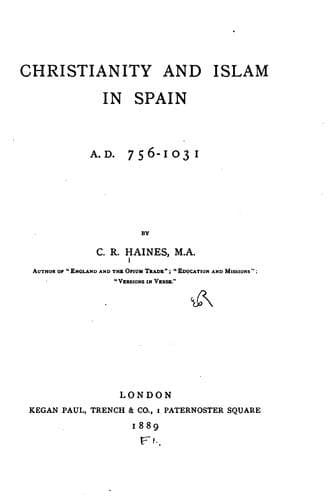
Christianity and Islam in Spain, A.D. 756-1031Haines, Charles Reginald
Islamic
Christianity and Islam in Spain, A.D. 756-1031
Haines, Charles Reginald
Christian martyrs -- Spain; Christianity -- Spain; Islam -- Spain
Again, contrary to the invariable practice elsewhere, women were
admitted into the mosques in Spain. This was forbidden by Mohammedan
law,[4] the women being obliged to perform their devotions at home;
"if," says Sale, "they visit the mosques, it must be when the men are
not there; for the Moslems are of opinion that their presence inspires a
different kind of devotion from that which is requisite in a place
dedicated to the service of God." Sale also quotes from the letter of a
Moor, censuring the Roman Catholic manner of performing the mass, for
the reason, among others, that women were there. If the evidence of
ballads be accepted, we shall find the Moorish ladies appearing at
festivities and dances.[5] At tournaments they looked on, their bright
smiles heartening the knights on to do brave deeds, and their fair hands
giving the successful champion the meed of victorious valour.[6] Their
position, in fact, as Prescott remarks, became assimilated to that of
Christian ladies.
[1] Murphy, "Hist. of Moh. Empire in Spain," p. 232.
[2] Conde, i. p. 457.
[3] For others see Conde, i. 483, 484.
[4] Sale, Introd., Koran, p. 84. (Chandos Classics.)
[5] Prescott, "Ferd. and Isab.," p. 158.
[6] See a picture in the Alhambra, given in Murphy's "Moorish
Antiquities of Spain," Lockhart, Pref., p. 13; and the ballad
called "The Bullfight of Ghazal," st. v. p. 109.
The effect of this improvement in the social position of women could not
fail to reflect itself in the conception of love among the Spanish
Arabs; and, accordingly, we find their gross sensuality undergoing a
process of refinement, as the following extract from Said ibn Djoudi,[1]
who wrote at the close of the ninth century, will shew. Addressing his
ideal mistress, Djehama, he says:--
"O thou, to whom my prayers are given,
Compassionate and gentle be
To my poor soul, so roughly driven,
To fly from me to thee.
"I call thy name, my vows outpouring,
I see thine eyes with tear-drops shine:
No monk, his imaged saint adoring,
Knows rapture like to mine!"
Of these words Dozy[2] says:--"They might be those of a Provençal
troubadour. They breathe the delicateness of Christian chivalry."
This Christianising of the feeling of love is even more clearly seen in
a passage from a treatise on Love by Ali ibn Hazm, who was prime
minister to Abdurrahman V. (Dec. 1023-Mar. 1024). He calls Love[3] a
mixture of moral affection, delicate gallantry, enthusiasm, and a calm
modest beauty, full of sweet dignity. Being the great grandson of
Christian parents, perhaps some of their inherited characteristics
reappeared in him:--"Something pure, something delicate, something
spiritual which was not Arab."[4]
[1] Killed, 897.
[2] II. 229.
[3] Quoted by Dozy, iii. 350.
[4] Dozy, 1.1.
CHAPTER XI.
INFLUENCE OF ISLAM ON CHRISTIANITY.
Public-domain text, read in full here on John Shaqi.
Reviews
Reviews
No reviews yet
Be the first to share your thoughts on this work.
Elsewhere in the archive
Join the Discussion
Join the discussion
Sign in to leave a comment or review.
Sign InorCreate an account