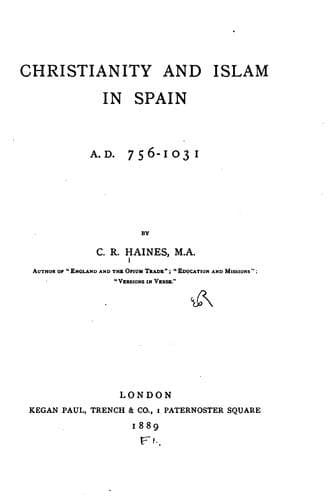
Christianity and Islam in Spain, A.D. 756-1031 — John Shaqi
Christianity and Islam in Spain, A.D. 756-1031Haines, Charles Reginald
Islamic
Christianity and Islam in Spain, A.D. 756-1031
Haines, Charles Reginald
Christian martyrs -- Spain; Christianity -- Spain; Islam -- Spain
With the fall of Arianism came a large accession of bigotry to the
Spanish Church, as is sufficiently shewn by the canon above quoted from
the Sixth Council of Toledo. A subsequent law was even passed forbidding
anyone under pain of confiscation of his property and perpetual
imprisonment, to call in question the Holy Catholic and Apostolic
Church; the Evangelical Institutions; the definitions of the Fathers;
the decrees of the Church; and the Sacraments. In the spirit of these
enactments, severe measures were taken against the Jews, of whom there
were great numbers in Spain. Sisebert (612-621) seems to have been the
first systematic persecutor, whose zeal, as even Isidore confesses, was
"not according to knowledge."[1] A cruel choice was given the Jews
between baptism on the one hand, and scourging and destitution on the
other. When this proved unavailing, more stringent edicts were enforced
against them. Those who under the pressure of persecution consented to
be baptised, were forced to swear by the most solemn of oaths that they
had in very truth renounced their Jewish faith and abhorred its rites.
Those who still refused to conform were subjected to every indignity and
outrage. They were obliged to have Christian servants, and to observe
Sunday and Easter. They were denied the _s connubii_ and the _ius
honorum_. Their testimony was invalid in law courts, unless a Christian
vouched for their character. Some who still held out were even driven
into exile. But this punishment could not have been systematically
carried out, for the Saracen invasion found great numbers of Jews still
in Spain. As Dozy[2] well says of the persecutors--"On le voulut bien,
mais on ne le pouvait pas."
[1] Apud Florez, "Esp. Sagr.," vol. vi. p. 502, quoted by
Southey, Roderic, p. 255, n. "Sisebertus, qui in initio regni
Judaeos ad fidem Christianam permovens, aemulationem quidem
habuit, sed non secundum scientiam: potestate enim compulit,
quos provocare fidei ratione oportuit. Sed, sicut est scriptum,
sive per occasionem sive per veritatem Christus annunciatur, in
hoc gaudeo et gaudebo."
[2] "History of Mussulmans in Spain," vol. ii. p. 26.
Naturally enough, under these circumstances the Jews of Spain turned
their eyes to their co-religionists in Africa; but, the secret
negotiations between them being discovered, the persecution blazed out
afresh, and the Seventeenth Council of Toledo[1] decreed that relapsed
Jews should be sold as slaves; that their children should be forcibly
taken from them; and that they should not be allowed to marry among
themselves.[2]
[1] Canon 8, de damnatione Judaeorum.
[2] For the further history of the Jews in Spain, see Appendix
A.
Public-domain text, read in full here on John Shaqi.
Reviews
Reviews
No reviews yet
Be the first to share your thoughts on this work.
Join the Discussion
Join the discussion
Sign in to leave a comment or review.
Sign InorCreate an account