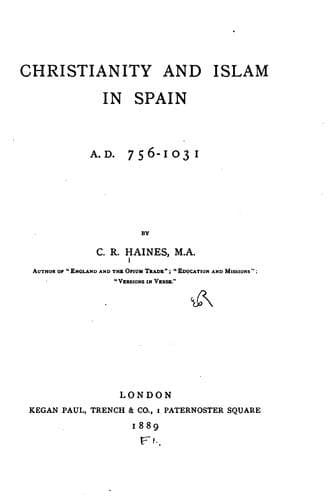
Christianity and Islam in Spain, A.D. 756-1031Haines, Charles Reginald
Islamic
Christianity and Islam in Spain, A.D. 756-1031
Haines, Charles Reginald
Christian martyrs -- Spain; Christianity -- Spain; Islam -- Spain
However that may have been, and it certainly looks very improbable, the
invasion did not help the pope much directly, though indirectly, and as
events turned out, the Arab domination was undoubtedly the main cause of
the ultimate subjection of Spain to the papal yoke, which happened in
this way:--The Christian Church in the North being, though free, yet in
a position of great danger and weakness, would naturally have sought
help from their nearest Christian neighbours, the Franks. But the
selfish and ambitious policy of the latter, who preferred extending
their temporal dominion to fighting as champions of Christianity in
defence of others, naturally forced the Spanish Christians to look to
the only Christian ruler who could afford them even moral assistance;
and the popes were not slow to avail themselves of the opportunity thus
offered for establishing their authority in a new province. It was by
the intervention of the popes that the war against the Arabs partook of
the nature of a crusade, a form of warfare which carried with it the
advantage of filling the treasury of the Bishops of Rome. By means of
indulgences, granting exemption from purgatory at 200 maravedis a head,
the pope collected in four years the sum of four million maravedis.[1]
The first important instance of the Pope's intervention being asked and
obtained was in 808, when, the body of St James being miraculously
discovered, Alfonso wrote to the pope asking leave to move the see of
Ira Flavia (Padron) to the new church of St lago,[2] built on the spot
where the relics were found. The birth of the new Spanish Church dates
from this event, which was of ominous import for the future independence
of the Church in that country. What the claims of Rome had come to be
within a quarter of a century of this epoch, we may see from the
controversy which arose between Claudius, Bishop of Turin, and the papal
party. Claudius was himself a Spaniard, and a pupil of the celebrated
Felix, Bishop of Urgel, one of the authors of the Adoptionist heresy.
Among other doctrines obnoxious to the so-called Catholic party,
Claudius stoutly resisted the papal claim to be the head of Christendom,
resting his opposition, so far as we can gather from what remains to us
of his writings,[3] on the grounds, first, that Christ did _not_ say to
Peter, "What thou loosest in heaven, shall be loosed upon earth;"
meaning by this that the authority vested in Peter was only to be
exercised during his life; secondly, in answer to the supposed efficacy
of a pilgrimage to Rome, Claudius retorts on his accuser, Theodomir,
abbot of a monastery near Nîmes:--"If a doing of penance to be effectual
involves a journey to Rome, why do you keep so many monks in your
monastery and prevent them from going--as you say is necessary--to Rome
itself?" As to the journey itself, Claudius said that he neither
approved nor disapproved of it, knowing that it was not prejudicial to
Public-domain text, read in full here on John Shaqi.
Reviews
Reviews
No reviews yet
Be the first to share your thoughts on this work.
Elsewhere in the archive
Join the Discussion
Join the discussion
Sign in to leave a comment or review.
Sign InorCreate an account