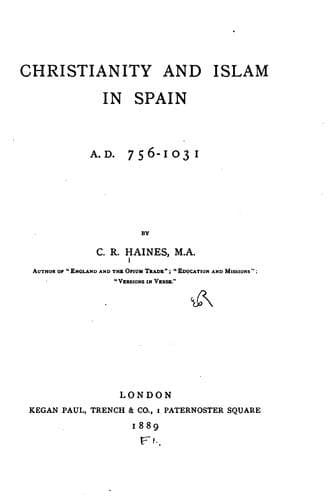
Christianity and Islam in Spain, A.D. 756-1031Haines, Charles Reginald
Islamic
Christianity and Islam in Spain, A.D. 756-1031
Haines, Charles Reginald
Christian martyrs -- Spain; Christianity -- Spain; Islam -- Spain
all, nor useful to all: but this he was assured of, that eternal life
could not be gained by a mere journey to Rome; thirdly, as to the pope
being the Dominicus Apostolicus, as his supporters called him,
apostolic, says Claudius, is a title that does not belong to one "who
fills the see of an apostle, but who fulfils the duties thereof."
[1] Prescott, "Ferd. and Isab.," p. 64, n.
[2] Romey, "Hist. d'Esp.," iii. 420.
[3] Jonas of Orleans, iii., apud Migne, vol. civ. p. 375 ff.
Fleury, v. 398.
Being summoned to appear before a council, the bishop proved
contumacious, and refused to go, calling the proposed assemblage a
congregation of asses. In spite of his independence of spirit Claudius
remained Bishop of Turin till his death in 839.
The pope's authority being once recognised in Spain, the sphere of his
interference rapidly enlarged, and we soon find the king unable even to
call a council of bishops without a papal bull. This became the
established practice.[1] In the tenth century Bermudo II. (982-999), in
confirming the laws of the Goths, took the opportunity to make the
canons and decrees of the pope binding in secular cases.[2]
Meanwhile, even before the free Christians in the North had established
their independence, the weakness of the Christian Church under Arab
domination seemed to afford a good opportunity for obtaining from them a
recognition of the authority of the pope. We accordingly find that an
appeal was made to the pope towards the close of the eighth century to
give an authoritative decision with regard to what the appellants deemed
to be certain irregularities which had found their way into the practice
of those Christians who were under the Arab yoke. The Pope Adrian
readily undertook to define what was, and what was not, in accordance
with Christianity. In a letter addressed to the Bishops of Spain he
inveighs against the following errors, countenanced by a certain
Migetius, and by Egila, Bishop of Elvira, and sometimes called in
consequence the Migetian errors:--
_(a.)_ The wrong celebration of Easter. This had already been noticed
and condemned by Peter, a deacon of Toledo, in a letter to the people of
Seville (750).[3] The error was not the same as that of the
Quarto-decimani, but consisted apparently in deferring Easter to the
twenty-second day, if the full moon fell on the 14th, and the following
day was Sunday. Curiously enough this very error had been held by the
Latin Church itself till the sixth century.[4] The fulminations of the
Pope failed in suppressing the error. As late as 891 it was sufficiently
general in Andalusia to cause the date of a battle which took place at
the Easter of that year to be placed in the year of the Hegira 278,
which only began on April 15th, whereas had Easter been observed
according to the usage of the Latin Church, the Paschal feast would have
been already past.[5]
Public-domain text, read in full here on John Shaqi.
Reviews
Reviews
No reviews yet
Be the first to share your thoughts on this work.
Elsewhere in the archive
Join the Discussion
Join the discussion
Sign in to leave a comment or review.
Sign InorCreate an account