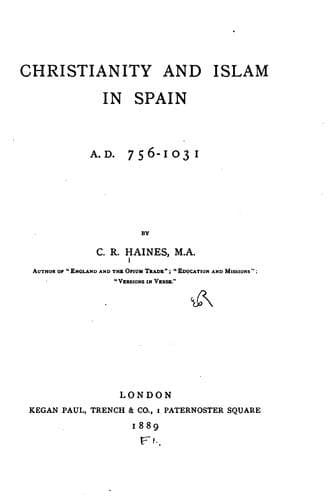
Christianity and Islam in Spain, A.D. 756-1031Haines, Charles Reginald
Islamic
Christianity and Islam in Spain, A.D. 756-1031
Haines, Charles Reginald
Christian martyrs -- Spain; Christianity -- Spain; Islam -- Spain
Rumours of these discrepancies in religious ritual reached Rome, and
accordingly a legate,[1] named Zanclus, was sent to Spain in 925 from
John X. to inquire into matters of religion, and particularly into the
ceremony of the mass, the opinion being prevalent at Rome that the mass
was incorrectly performed according to the Gothic liturgy, and that
false doctrines were taught. However, Zanclus found that the divergence
was not sufficiently wide to warrant the suppression of the ancient
ritual. It may be that the power of the Roman Church was not established
so securely as to admit of an interference so unpalatable to the ancient
church. She was content to bide her time; for such a standing witness
to the primitive usage[2] of the Church against the innovations of the
Roman See could not long be allowed to continue. Accordingly, we find
that very soon after the fall of Toledo in 1085, the question of the old
Gothic liturgy came up for discussion again. The Gothic and the Roman
books were subjected, after the absurd fashion of the times, to two
ordeals--by water and by fire; but in spite of the fact that the Gothic
liturgy, thanks to its greater solidity and stronger binding, resisted
both those elements incomparably better than its younger rival, and so,
if the ordeal went for anything, should have been hailed victorious, the
old native liturgy was partially suppressed at the bidding of the pope,
and by the consent of the Spanish king Alfonso VI. of Leon,[3] and
Sancho IV. of Aragon. Yet the Muzarabic Christians were loath to give up
their customary liturgy, and it remained in use in several churches of
Toledo till late in the fifteenth century.
[1] Mariana, vi. 9. Pseudo-Luit. gives the legate the name of
Marinus, and says he was sent in 932 to Basilius, Bishop of
Toledo.
[2] Cp. the monstrous way in which the Portuguese Roman
Catholics, under Don Alexis de Menezes, destroyed the sacred
books and memorials of the ancient Syrian Church on the Malabar
coast in India.
[3] And I. of Castile.
Public-domain text, read in full here on John Shaqi.
Reviews
Reviews
No reviews yet
Be the first to share your thoughts on this work.
Elsewhere in the archive
Join the Discussion
Join the discussion
Sign in to leave a comment or review.
Sign InorCreate an account