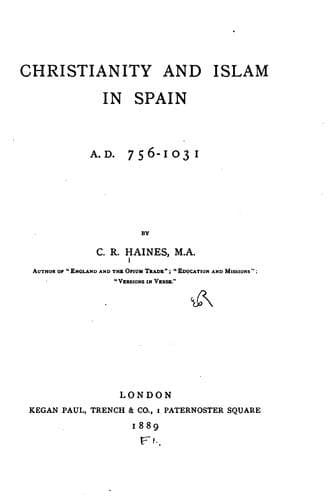
Christianity and Islam in Spain, A.D. 756-1031Haines, Charles Reginald
Islamic
Christianity and Islam in Spain, A.D. 756-1031
Haines, Charles Reginald
Christian martyrs -- Spain; Christianity -- Spain; Islam -- Spain
But the interference of the pope was not confined to matters relating to
the Spanish Church at large, his heavy hand fell upon the king himself,
and at the end of the twelfth century Alfonso IX. and all his kingdom
were laid under an interdict by Celestine III. because he had married
within forbidden limits, and refused to divorce his wife at the bidding
of the pope. He did in the end divorce her, but only to repeat the same
offence with a second wife, Berengaria, and incur the same penalty at
the hands of Innocent III. Encroachments on the king's power went on
apace, and gradually appeals came to be referred to Rome from the king's
courts, and the pope took upon himself to appoint to benefices and
bishoprics; a usurpation which was countenanced by Alfonso X.
(1252-1284).[1] But this result was not attained without remonstrances
from the Cortes, and finally, under Ferdinand and Isabella, the question
came to an open rupture between the Spanish Court and the reigning pope,
Sixtus IV. Isabella, though so ready to submit herself in matters of
personal religion to the pope and his legates, refused, like her later
namesake of England, to bate one jot of her ecclesiastical rights; and
the pope had to give way, contenting himself with the barren power of
appointing those nominated by the sovereigns of the land. But if the
sovereign was jealous of his rights, no less so were the barons of
theirs, and when in the war of the barons with Henry IV. (1454-1474),
the papal legate threw his influence on to the king's side, and
excommunicated the rebellious barons, they firmly answered that "those
who had advised the pope that he had a right to interfere in the
temporal concerns of Castile had deceived him; and that they, the barons
of the kingdom, had a perfect right to depose their sovereign on
sufficient grounds, and meant to exercise it."[2]
A similarly independent spirit shewed itself in Aragon. In 1213 Pedro
II. died fighting against the papal persecutor of the Albigensians, and
down to the time of Charles V., the princes of Aragon were at open
enmity with the Roman See,[3] and the Aragonese strenuously resisted the
establishment of the Inquisition.[4]
[1] Prescott, "Ferd. and Isab.," p. 15.
[2] Prescott, p. 72. Cp. the charter of Aragon, whereby the
king, if he violated the charter of the realm, might be
deposed, and any other _Pagan_ or Christian substituted.
_Ibid_, p. 23.
[3] Lockhart, Introduction to Spanish ballads, p. 9. (Chandos
Classics.)
[4] Prescott, "Ferd. and Isab.," p. 26, n.
Public-domain text, read in full here on John Shaqi.
Reviews
Reviews
No reviews yet
Be the first to share your thoughts on this work.
Elsewhere in the archive
Join the Discussion
Join the discussion
Sign in to leave a comment or review.
Sign InorCreate an account