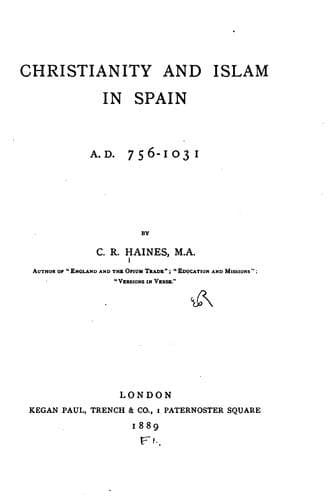
Christianity and Islam in Spain, A.D. 756-1031 — John Shaqi
Christianity and Islam in Spain, A.D. 756-1031Haines, Charles Reginald
Islamic
Christianity and Islam in Spain, A.D. 756-1031
Haines, Charles Reginald
Christian martyrs -- Spain; Christianity -- Spain; Islam -- Spain
This is the first definite indication we have that the toleration shown
by the Moslems was beginning to be abused by their Christian subjects;
and there can be no reasonable doubt that this ill-advised conduct on
the part of the latter was the main cause of the so-called persecution
which followed. But besides this fanaticism on the part of a small
section of the subject Christians, there were other causes at work
calculated to produce friction between the two peoples. During the
century which had elapsed since the conquest, the Christians and
Mohammedans, living side by side under the same government, and one
which, considering the times in which it arose, was remarkable no less
for its equity and moderation than for its external splendour and
magnificence, had gradually been drawn closer together. Intermarriages
had become frequent among them;[1] and these proved the fruitful cause
of religious dissensions. Accordingly we find that the religious
troubles in the reigns of Abdurrahman II. (822-852) and Mohammed I.
(852-886) began with the execution of two children of mixed parents.
Nunilo and Alodia were the children of a Moslem father and a Christian
mother. Their father was a tolerant man, and, apparently, while he
lived, permitted his children to profess the faith of their mother. On
his death, the mother married again, and the new husband, being a
bigoted Mohammedan, and actuated, as we may suppose, by the _odio
vitrici_, immediately set about reclaiming his step-children to the true
faith of Islam, his efforts in this direction leading him to ill-treat,
even to torture,[2] the young confessors. His utmost endeavour to effect
their conversion failing, he delivered them over to the judge on the
charge of apostasy, and the judge to the executioner, by whom they were
beheaded on Oct. 21, 840.[3]
[1] Due in part no doubt to the marriage of captives. See also
below for "the maiden tribute," pp. 96, 97.
[2] So Miss Yonge.
[3] This date is given by Morales, apud Migne, vol. cxv. p.
886, and by Fleury, v. 487, who accuse Eulogius, "Mem. Sanct.,"
ii. c. 10, of being in error when he assigns the date 851. The
Pseudo-Luitprand gives 951, vouching for this date as an
eye-witness: "Me vivente, in castro Wergeti, id est Castellon,
etc."
Public-domain text, read in full here on John Shaqi.
Reviews
Reviews
No reviews yet
Be the first to share your thoughts on this work.
Join the Discussion
Join the discussion
Sign in to leave a comment or review.
Sign InorCreate an account