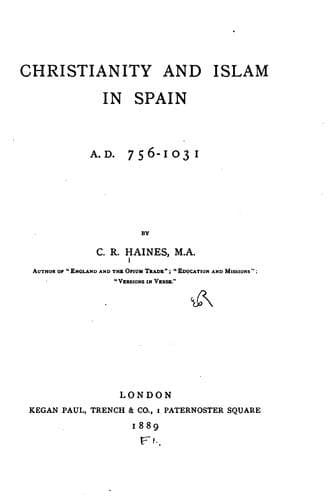
Christianity and Islam in Spain, A.D. 756-1031Haines, Charles Reginald
Islamic
Christianity and Islam in Spain, A.D. 756-1031
Haines, Charles Reginald
Christian martyrs -- Spain; Christianity -- Spain; Islam -- Spain
Isaac's conduct and fate, Eulogius tells us, electrified the people, who
were amazed at the _newness_ of the thing.[4] It was at this point that
Eulogius himself began to shew his sympathy with these fanatical doings
by encouraging and helping others to follow Isaac's example.
[1] Eulogius, "Mem. Sanct.," Pref., sec. 5, "_Ore pudico_
summisque reverentiae ausibus viribusque."
[2] Cp. Acts xxiii. 3.
[3] Eulog., "Lib. Apolog.," sec. 35, mentions a proposed edict
of the authorities, visiting the seeker of relics with severer
penalties.
[4] See Eulog., Letter to Alvar, apud Florez., xi. 290.
The number of misguided men and women that now came forward and threw
their lives away is certainly remarkable, and seems to have struck the
Moslems as perfectly unaccountable. The Arabs themselves were as brave
men as the world has ever seen, and, by the very ordinances of their
faith, were bound to adventure their lives for their religion in actual
human conflict with infidel foes, yet they were unable to conceive how
any man in his senses could willingly deprive himself of life in such a
way as could do no service to the cause, religious or other, which he
had at heart. They were quite unable to appreciate that intense
antagonism towards the world and its perilous environment, which
Christianity teaches; that spirit of renouncement of the vanities, nay,
even of the duties of life, which prompted men and women to immure
themselves in cloisters and retreats, far from all spheres of human
usefulness. Life under these circumstances had naturally little to make
it worth the living, and became all the more easy to relinquish, when
death, in itself a thing to be desired, was further invested with the
glories of martyrdom.
The example of Isaac was therefore followed within two days by a monk
named Sanctius[1] or Sancho, who was executed on June 5th. Three days
later were beheaded Peter, a priest of Ecija; Walabonsus, a deacon of
Ilipa; Sabinianus and Wistremundus, monks of St Zoilus; Habentius, a
monk of St Christopher's Church at Cordova; while Jeremiah,[2] uncle of
Isaac, was scourged to death. Their bodies were burned, and the ashes
cast into the river.
Sisenandus of Badajos[3] found a similar fate on July 16th: four days
subsequently Paul, a deacon of St Zoilus, gave himself up; and the same
number of days later, Theodomir, a monk of Carmona: all of whom were
beheaded.
[1] Eulog., "Mem. Sanct.," ii. c. 3.
[2] _Ibid._, c. iv.
[3] After his martyrdom he procured the release from prison of
Tiberias, priest of Beja! Eulog., "Mem. Sanct.," ii. c. vi.
CHAPTER IV.
FANATICISM OF THE MARTYRS.
The next candidates for martyrdom were two young and beautiful girls,
whose history we learn from their patron, Eulogius, who seems to have
regarded one of these maidens, Flora, with a Platonic love mingled with
a sort of religious devotion.
Public-domain text, read in full here on John Shaqi.
Reviews
Reviews
No reviews yet
Be the first to share your thoughts on this work.
Join the Discussion
Join the discussion
Sign in to leave a comment or review.
Sign InorCreate an account