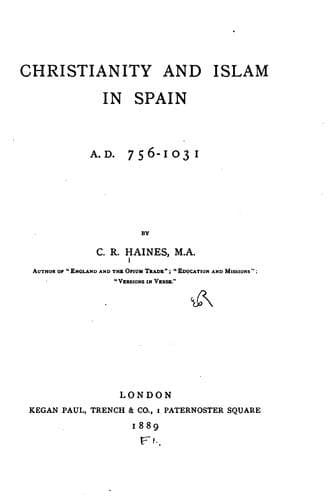
Christianity and Islam in Spain, A.D. 756-1031Haines, Charles Reginald
Islamic
Christianity and Islam in Spain, A.D. 756-1031
Haines, Charles Reginald
Christian martyrs -- Spain; Christianity -- Spain; Islam -- Spain
In one of his works on this subject, Eulogius expresses a fear lest the
intervention of the martyrs should bring disaster on the Church in
Spain, just as the intervention of Moses in Egypt did much at first to
aggravate the hardships of the Israelites.[1] He ought not, therefore,
to have been surprised, when such a result actually did follow; nor
ought he to complain that now the Moslems would only let the Christians
observe their religion in such a way as they chose to dictate; and that
the Christians were subjected to all sorts of taxes and exactions.[2]
These combined measures of repression, taken by the King and the Bishop
of Seville, soon produced their effect. The extreme party were broken
up, some escaping to quieter regions, others hiding, and only venturing
abroad in disguise and at night--not, as Eulogius is careful to add,
from fear of death, but because the high prize of martyrdom is not
reserved for the unworthy many, but for the worthy few.[3]
[1] _Ibid._, ii. c. xvi.
[2] Eulog., "Doc. Mart.," sec. 18--"_Nunc_ pro suo libito
tantummodo exercere nos sinentes Christianismum ... _nunc_
publicum imponentes censum, _nunc_ rebus nos abdicantes
detrimentis atterunt rerum."
[3] Eulog., "Mem. Sanct.," ii. sec. 14--"Quia indigni sumus
martyrio, quod quibusdam et non omnibus datum est."
Some even apostatized,[1] while many of those who had applauded the
proceedings of the martyrs, now called them indiscreet, and blamed them
for indulging in a selfish desire to desert the suffering Church for an
early mansion in the skies.[2] Others, in order to retain posts under
Government, or to court favour with the King, dissembled their religion,
taking care not to pray, or make the sign of the cross in public.[3]
Eulogius himself was singled out at the meeting of the King's Council by
one of the royal secretaries, Gomez, son of Antonian, son of Julian,[4]
as the ringleader of the new seditious movement. This man was a very
worldly-minded Christian,[5] and was, no doubt, at this time, in fear of
losing his lucrative office at Court, which he had obtained by his
remarkable knowledge of Arabic. He did, in fact, lose his post with all
the other Christian officers of the Court, but regained it by becoming a
Moslem;[6] and such was the ardour of the new proselyte that he was
called "the dove of the mosque."[7]
The result of this council was, as we have seen, hostile to the party of
which Eulogius and Saul were the chiefs, but the former writer,
mentioning the actual decree that was passed, pretends that it was
merely a blind to deceive the king, and spoken figuratively; and he
acknowledges that such hypocrisy was unworthy of the prelates and
officers assembled.[8] Is it not more reasonable to suppose that
Eulogius and his supporters voted for it--as they seem to have
done--with a mental reservation, while their opponents honestly
considered such a step necessary?
Public-domain text, read in full here on John Shaqi.
Reviews
Reviews
No reviews yet
Be the first to share your thoughts on this work.
Elsewhere in the archive
Join the Discussion
Join the discussion
Sign in to leave a comment or review.
Sign InorCreate an account