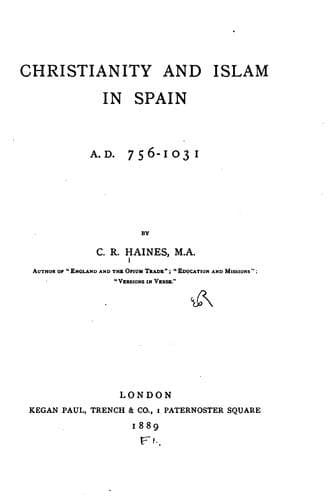
Christianity and Islam in Spain, A.D. 756-1031Haines, Charles Reginald
Islamic
Christianity and Islam in Spain, A.D. 756-1031
Haines, Charles Reginald
Christian martyrs -- Spain; Christianity -- Spain; Islam -- Spain
John of Gorz now proposes the only practicable course, that Abdurrahman
should send a fresh embassy to Otho and ask for instructions for his
ambassadors under the circumstances. Recemundus,[1] a Christian, offers
to go as ambassador, if a vacant bishopric be given him as a reward. He
sets out and reaches Gorz in February 956. Otho gives him a fresh
letter, with instructions to suppress the former one, to conclude an
alliance with the Sultan, and make an arrangement with him for putting
down the brigands who infested the marches.
[1] De Gayangos, on Al Makkari, ii. p. 464, identifies him with
Rabi, a bishop mentioned as an ambassador of Abdurrahman III.
in Al Makkari, i. 236, ii. 139; but Rabi may have been the
bishop who died during the embassy to Otho. Recemundus, as De
Gayangos (1.1.) says, was a katib or clerk of the palace.
Leaving Gorz with Dudo, the emperor's legate, on March 30, he reached
Cordova on June 1st, but the Sultan declined to receive the second
comers till he had received the earlier embassy. So, after three years
semi-captivity, John is released, and told to prepare himself for the
king's presence by shaving, washing, and putting on new apparel. He
declines to go in any otherwise than he is; and even when the king,
thinking his refusal due to poverty, sends him a sum of money, the monk
accepts the gift and distributes it to the poor, but says he will only
see the king as a poor monk. The king good-naturedly said: "Let him come
as he likes." On June 21, 956, the ambassadors were conducted to the
king's presence along a road thronged with sight-seers. The steps of the
palace were laid down with tapestry, and a guard of honour lined both
sides of the approach. On John's entrance, the king, as a great mark of
distinction, gave him his open palm to kiss, and beckoned him to a seat
near his own couch. After a silence Abdurrahman apologised to the monk
for the long delay which he had been obliged to impose on the embassy,
and which was in no sense due to disrespect for John himself, whose
virtue and wisdom he could not but acknowledge. As a proof that this was
no mere empty compliment, the king expressed his readiness to give him
whatever he asked. John's wrath vanishes at these gracious words, and
they talk amicably together. But when the monk asks leave to depart
Abdurrahman says:--"After waiting so long to see one another, shall we
part so soon?" He suggests that they should have at least three
interviews. At their next meeting they discourse on the respective power
of the empires of Otho and the Khalif himself; and the Sultan, taught by
the experience of Spain, points out the unwisdom of allowing feudal
subjects to become too powerful, by dividing kingdoms between them.
Public-domain text, read in full here on John Shaqi.
Reviews
Reviews
No reviews yet
Be the first to share your thoughts on this work.
Elsewhere in the archive
Join the Discussion
Join the discussion
Sign in to leave a comment or review.
Sign InorCreate an account