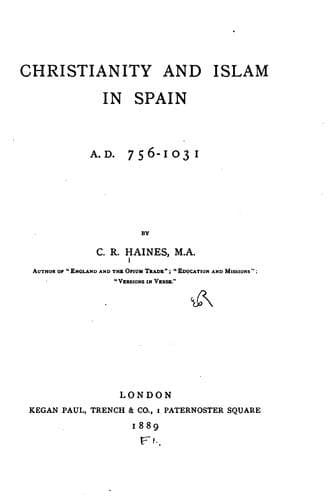
Christianity and Islam in Spain, A.D. 756-1031Haines, Charles Reginald
Islamic
Christianity and Islam in Spain, A.D. 756-1031
Haines, Charles Reginald
Christian martyrs -- Spain; Christianity -- Spain; Islam -- Spain
The king employs Hasdai, a Jew, as his go-between; who warns them not to
divulge the contents of the letter, as it would make them liable to
punishment; for the letter contained what Moslems would consider
blasphemy against their Prophet. Soon after this John, the Bishop of
Cordova, is sent to them to suggest that they should carry their gifts
to the king, and say nothing of the letter. But John of Gorz stoutly
refused to do this, saying that the delivery of the letter was his chief
duty, and that as Abdurrahman had begun by reviling Christ, he must not
be surprised at Otho's retaliating against Mohammed. However, John of
Cordova begs him to remember the position in which the Christians stood,
viz., under Pagan rule. "We are forbidden," he said, "by the apostle to
resist the powers that be. In our calamity, we have this one
consolation, we are allowed to observe our own laws and rites, and our
rulers, if they see us diligent in our religion, honour us, cherish us,
and delight in our society, while they abhor the Jews. As our religion,
then, suffers no harm at their hands, let us obey the Moslems in other
things." The bishop was anxious, therefore, that the letter should be
suppressed, as calculated to do harm to the Christian community, and no
good to Otho. His advice, however, fell on deaf ears. The monk of Gorz
was resolved on doing what he deemed his plain duty; nor was he content
to forego his chance of martyrdom, though his action might entail
disastrous consequences on the Christians subject to the Moors. He
taunted the bishop with giving his advice from a fear of man. "Better
die of hunger than eat the salt of unbelievers;" and expressed horror at
the fact that the bishop was circumcised, and also abstained from
certain meats in deference to Moslem scruples. It was in vain that the
bishop pointed out that otherwise they could not live with the Saracens.
John of Gorz now expressed his intention of delivering the letter
forthwith; but the king denied the ambassadors an audience, leaving them
to themselves for six or seven weeks. Early in 955, however, the king
sent to them, and asked if they held firm to their previous resolve, and
on receiving an answer in the affirmative, he threatened all the
Christians in his dominions with loss of privileges and even death. John
of Gorz merely answers that the guilt would be on the king's head; but
the latter is persuaded to milder counsels by his advisers, who remind
him of Otho's power, and the certainty that he would interfere in favour
of his ambassadors.
Public-domain text, read in full here on John Shaqi.
Reviews
Reviews
No reviews yet
Be the first to share your thoughts on this work.
Elsewhere in the archive
Join the Discussion
Join the discussion
Sign in to leave a comment or review.
Sign InorCreate an account