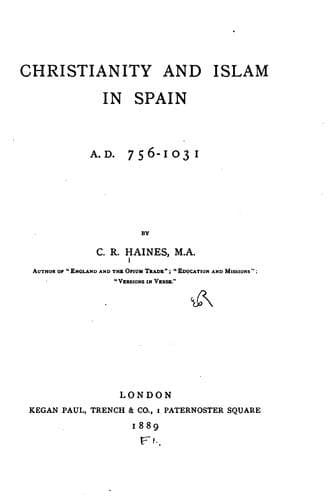
Christianity and Islam in Spain, A.D. 756-1031Haines, Charles Reginald
Islamic
Christianity and Islam in Spain, A.D. 756-1031
Haines, Charles Reginald
Christian martyrs -- Spain; Christianity -- Spain; Islam -- Spain
Not only were the Christians allowed to practise their religion, but
even, as we have seen above, encouraged in it.[4] Almanzor, the champion
of Islam, allowed his Christian servants to rest on Sundays. Christians
in every reign held high posts at court[5] and throughout the land, and
not only timeserving Christians but men like Samson and Leovigild, who
were known to sympathise with the party of zealots, were employed by the
king to write letters to, and negotiate with, the neighbouring kings.
This was no doubt due to their general trustworthiness, their quickness,
and their knowledge of Arabic as well as Latin.
[1] Ezekiel xxxiii. 11.
[2] Prescott, "Ferd. and Isab.," p. 376, n.
[3] Mariana, ix. 10.
[4] See p. 57. Recent history affords a similar instance from
the Christian side. See "Gordon in Central Africa," p. 54--"I
have made them make a mosque, and keep the Ramadhan." _Ibid._,
p. 249, "I had the mosque cleared out and restored for worship,
and endowed the priests and crier, and had a great ceremony at
the opening of it.... They blessed me and cursed Zebehr Pasha
who took the mosque from them. To me it appears that the
Mussulman worships God as well as I do, and is as acceptable,
if sincere, as any Christian."
[5] Such as secretary, farmer of taxes, or even prime minister.
Among the great functionaries of state there was one who held the office
of Kitabatu-dh-dhimam, which, being interpreted, is "the office of
protection." The Christians and Jews were under his general
jurisdiction, and were called "the people of the protection."[1] But
besides this Arab "Secretary of State for the Christians," the latter
had their own counts--a relic of the Gothic system--who, however, did
not always stand up for their interests.[2] There were also Christian
censors,[3] but it is not known what position they held in the State.
The young Christian cadets of noble birth were brought up at Court, and
numbers of Sclavonian Christians served in the king's bodyguard, of whom
under Hakem I. (796-822) there were 2000.[4]
[1] Al Makk., i. p. 103; and De Gayangos' note, p. 398.
[2] _E.g._. Servandus. Cp. also Cyprianus.
[3] See above, p. 49.
[4] Conde, i. p. 260.
Public-domain text, read in full here on John Shaqi.
Reviews
Reviews
No reviews yet
Be the first to share your thoughts on this work.
Elsewhere in the archive
Join the Discussion
Join the discussion
Sign in to leave a comment or review.
Sign InorCreate an account