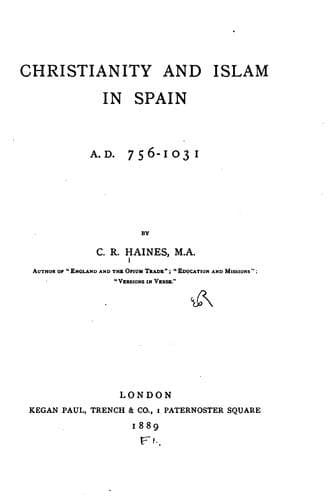
Christianity and Islam in Spain, A.D. 756-1031Haines, Charles Reginald
Islamic
Christianity and Islam in Spain, A.D. 756-1031
Haines, Charles Reginald
Christian martyrs -- Spain; Christianity -- Spain; Islam -- Spain
All things considered, it is a matter for surprise that these two
peoples, so unlike in race, habits, prejudices, and religion, lived so
comparatively quietly side by side in spite of a perpetual state of
warfare between the Arabs and the Christians in the North, which tended
to keep alive the animosities of the two races in that part of Spain
which was under Mohammedan rule.[1] Moreover, the pride of race was very
strong in the pure-blooded Arabs. Thus the poet Said ibn Djoud, in a
poem called the "battle of the town" (Polei), boasts that the conquerors
are of the pure race of Adnan and Kahtan, without any foreign admixture;
while he calls the defeated Spaniards miscreants, followers of a false
faith,[2] sons of the pale-faces. The haughty Arabs, in fact, were too
prone to look upon all the Spaniards, both renegades and Christians, as
mere canaille.[3]
But, in spite of this, the races to a certain extent amalgamated; and
Eulogius endeavours to prove that, but for the outbreak of fanaticism in
the middle of the ninth century, this amalgamation would have had
serious results for Christianity in Spain.[4]
The Arabs did not disdain to seek the alliance of the free Christian
States, nor were the latter averse from doing the same, when political
occasion demanded it. As early as 798 the Walis of the frontier cities
sought to make themselves independent by what the Arab writer describes
as "vile policy and unworthy acts," _i.e._, by seeking the friendship of
the Christian kings;[5] and there are many instances of these kings
asking aid, even servilely, from Arab princes.[6]
[1] Dozy, ii. 108, puts the distinction between the races very
forcibly:--"Ce peuple qui joignait à une gaité franche et vive
une sensualité raffinée devait inspirer aux prêtres, qui
aimaient les retraites éternelles et profondes, les grands
renoncéments et les terribles expiations, une répugnance
extrême et invincible."
[2] Dozy, ii. 223.
[3] "C'était leur terme consacrée." Dozy, ii. 211.
[4] "Heu pro dolor! quia esse sub Gentibus delicias computamus,
iugumque cum infidelibus ducere non renitimur. Et inde ex
cotidiano usu illorum sacrilegiis plerumque utimur et magis
ipsorum contubernia affectamus."--Eul., "Doc. Martyr," sec. 18.
[5] Conde, i. 244: "Chron. Alb.," vi. sec. 58: "Chron. Lib.,"
sec. 30.
[6] Al Makkari, ii. 161, Ordono the Bad and Hakem II.
Public-domain text, read in full here on John Shaqi.
Reviews
Reviews
No reviews yet
Be the first to share your thoughts on this work.
Elsewhere in the archive
Join the Discussion
Join the discussion
Sign in to leave a comment or review.
Sign InorCreate an account