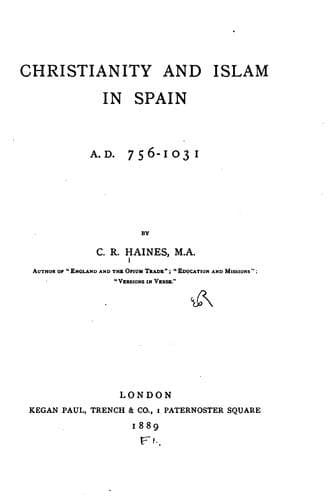
Christianity and Islam in Spain, A.D. 756-1031Haines, Charles Reginald
Islamic
Christianity and Islam in Spain, A.D. 756-1031
Haines, Charles Reginald
Christian martyrs -- Spain; Christianity -- Spain; Islam -- Spain
In spite of the close contact into which the Christians and Mohammedans
were brought in Spain, and the numerous conversions and frequent
intermarriages between the two sections, no thorough knowledge seems to
have existed, on either side, of the creed of the other party. Such, at
least, is the conclusion to which we are driven, on reading the only
direct records which remain on the subject among Arab and Christian
writers. These on the Christian side consist chiefly of quotations from
a book on Mohammedanism by the abbot Speraindeo in a work of his
disciple, Eulogius;[1] and some rather incoherent denunciations of
Mohammed and his religion by Alvar,[2] another pupil of the abbot's. In
these, as might be expected, great stress is laid on the sensuality of
Mohammed's paradise,[3] and the lewdness of the Prophet himself. As to
the latter, though many of Gibbon's coarse sarcasms do not rest on good
authority, very little can be said for the Prophet. But among other
blasphemies attributed by Speraindeo to Mohammed is one of which we find
no mention in the Koran--the assertion, namely, that he would in the
next world be wedded to the Virgin Mary. John, Bishop of Seville, is
equally incorrect when, in a letter to Alvar,[4] he alleges a promise on
the part of Mohammed that he would, like Christ, rise again from the
dead; whereas his body, being neglected by his relations, was devoured
by dogs. The Christian bishop does not hesitate to add--sepultus est in
infernum--he was buried in hell.[5]
[1] Eul., "Mem. Sanct.," i. sec. 7.
[2] Alvar, "Ind. Lum.," secs. 21-35.
[3] _Ibid._, secs. 23, 24. Mohammed's paradise was by no means
wholly sensual.--Sale's Koran. Introd., p. 78.
[4] Sec 9.
[5] This shows the hatred of Christians for Mohammed, whom,
says Eulogius ("Mem. Sanct.," i. sec. 20), it would be every
Christian's duty to kill, were he alive on earth.
It is generally supposed that Mohammed could neither read nor write, and
this appears to have been the opinion of Alvar;[1] but the same witness
acknowledges that the Koran was composed in such eloquent and beautiful
language that even Christians could not help reading and admiring it.[2]
On the important question of Mohammed's position with regard to
Christianity, Eulogius[3] at least formed a correct judgment. Mohammed,
he tells us "blasphemously taught that Christ was the Word of God,[4]
and His Spirit;[5] a great prophet,[6] endowed with much power from
God;[7] like Adam in His creation,[8] but not equal to God (the
Creator);[9] and that by reason of His blameless[10] life, being filled
with the Holy Spirit,[11] He showed marvellous signs and wonders through
the power of God,[12] not working by His own Godhead, but as a righteous
Man, and an obedient servant,[13] obtaining much power and might from
the Almighty God through prayer."
[1] Alvar, "Ind. Lum.," sec. 26.
[2] _Ibid._, sec. 29. This is more than can be said at the
present day.
Public-domain text, read in full here on John Shaqi.
Reviews
Reviews
No reviews yet
Be the first to share your thoughts on this work.
Elsewhere in the archive
Join the Discussion
Join the discussion
Sign in to leave a comment or review.
Sign InorCreate an account