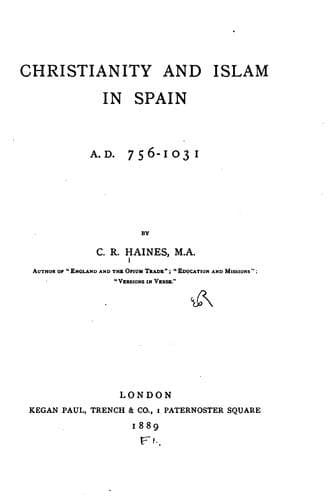
Christianity and Islam in Spain, A.D. 756-1031Haines, Charles Reginald
Islamic
Christianity and Islam in Spain, A.D. 756-1031
Haines, Charles Reginald
Christian martyrs -- Spain; Christianity -- Spain; Islam -- Spain
[3] Eul., "Lib. Apol.," sec. 19.
[4] Koran, ch. iii. 40.
[5] Koran, ch. ii. 81, "strengthened with Holy Spirit."
[6] Kor., c. iii. 59.
[7] Kor., c. iii. 45.
[8] Kor., c. iii. 50.
[9] Kor., c. ix. 33.
[10] Kor., c. iii.
[11] This is a mistake of Eulogius. See Sale's note on Koran,
ch. ii. 81, note.
[12] Kor., ch. v. 110 ff.
[13] Koran, cc. iv. ad fin; xliii. 59.
Alvar is much more unfair to Mohammed than his friend Eulogius, and he
even seems to have had a prejudiced idea[1] that the Prophet set himself
deliberately to preach doctrines the opposite of those taught by Christ.
It would be nearer to the truth to say that the divergence between the
two codes of morals was due to the natural ignorance of an illiterate
Arabian, brought into contact only with an heretical form of
Christianity, the real doctrines of which he was therefore not likely to
know.
According to Alvar, the sixth day of the week was chosen for the
Mohammedan holy day, because Christ suffered on that day. We shall
realise the absurdity of this when we consider the reverence in which
Mohammed held the very name of Christ, going so far even as to deny that
Christ Himself was crucified at all.[2] The true reason for selecting
Friday, as alleged by Mohammed himself, was, because the work of
creation ended on that day.[3]
Again, sensuality was preached, says Alvar, because Christ preached
chastity. But Mohammed cannot fairly be said to have preached
sensuality, though his private life in this respect was by no means
pure.
Public-domain text, read in full here on John Shaqi.
Reviews
Reviews
No reviews yet
Be the first to share your thoughts on this work.
Elsewhere in the archive
Join the Discussion
Join the discussion
Sign in to leave a comment or review.
Sign InorCreate an account