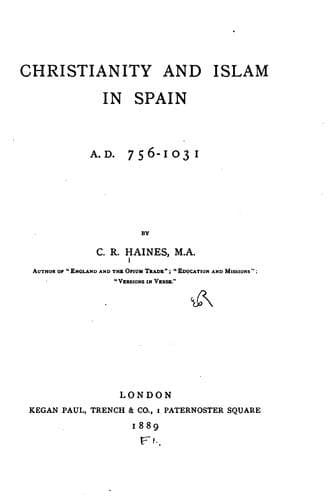
Christianity and Islam in Spain, A.D. 756-1031Haines, Charles Reginald
Islamic
Christianity and Islam in Spain, A.D. 756-1031
Haines, Charles Reginald
Christian martyrs -- Spain; Christianity -- Spain; Islam -- Spain
[7] See Blunt, Art. on Adoptionism.
To give an idea of the lines on which the controversy was carried on, it
will be necessary to state some of the arguments of Felix, and in
certain cases Alcuin's rejoinders. These are:--
_(a.)_ "If Christ, as man, is not the _adopted_ Son of God, then must
His Manhood be derived from the essence of God and consequently must be
something different from the manhood of men."[1] To this Alcuin can only
oppose another dilemma, which, however, is more of the nature of a
quibble. "If," he says, "Christ is an adopted Son of God, and Christ is
also God, then is God the adopted Son of God?"[2] Here Alcuin confounds
the predicates of Christ's two natures--the very thing Felix protested
against--and uses the argument thus obtained against that doctrine of
Felix, which was based on this very denial of any interchange of
predicates.
_(b.)_ Christ is spoken of sometimes as Son of David, sometimes as Son
of God. One person can only have two fathers, if one of these be an
adoptive father. So is it with Christ. Alcuin answers: "As a man (body
and soul) is called the son of his father, so Christ (God and man) is
called Son of God."[3] But to those who deny that a man's soul is
derived from his father, this argument would carry no weight.
_(c.)_ Christ stood in a position of natural dependence towards God over
and above the voluntary submission which He owed to His Father as
God.[4] This dependence Felix expresses by the term _servus
conditionalis_, applied to Jesus.[5] He may have been thinking of Matt.
xii. i8, "Behold my servant, whom I have chosen;" and St Paul's Ep. to
Philipp. ii. 7, "He took upon. Him the form of a servant, and was made
in the likeness of men."[6] Or perhaps he had in his mind, if the theory
of the influence of Mohammedanism is true, those passages of the Koran
which speak of Christ as a servant, as, "Christ doth not proudly disdain
to be a servant unto God,"[7] and, "Jesus is no other than a
servant."[8]
(_d._) To prove that Scripture recognises a distinction between Christ
the Man and Christ the God, Felix appeals to Luke xviii. 19, "Why
callest thou Me good? There is none good, save one, even God;" Mark
xiii. 32, "Of that day, or that hour, knoweth no one, not even the
angels in heaven, neither the Son, but the Father." Texts such as these
can only be met by a reference to other texts, such as John iii. 16,
where God is said to have given His only begotten Son to suffer death
upon the Cross.
[1] Alcuin contra Felicem, ii. sec. 12.
[2] Alcuin (_ibid.,_ i. sec. 13) also answers: "If Christ be
the adopted Son of God, because as man, he could not be of
God's substance: then must he also be Mary's adopted son in
respect to his Deity. But then Mary cannot be the mother of
God." But this Alcuin thinks an impious conclusion. Cp. also
Contra Felic., vii. sec. 2.
[3] Contra Felic, iii. sec. 2.
Public-domain text, read in full here on John Shaqi.
Reviews
Reviews
No reviews yet
Be the first to share your thoughts on this work.
Elsewhere in the archive
Join the Discussion
Join the discussion
Sign in to leave a comment or review.
Sign InorCreate an account