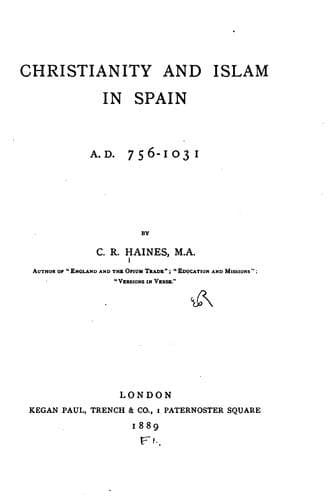
Christianity and Islam in Spain, A.D. 756-1031Haines, Charles Reginald
Islamic
Christianity and Islam in Spain, A.D. 756-1031
Haines, Charles Reginald
Christian martyrs -- Spain; Christianity -- Spain; Islam -- Spain
[4] Cp. 1 Corinth, xi. 3, "The Head of Christ is God." This
position of dependence was due, says Felix, "ad ignobilitatem
beatae Virginis, quae se ancillam Dei humili voce protestatur."
[5] Cp. Elipandus' "Confession of Faith": "... per istum Dei
simul et hominis Filium, adoptivum humanitate et nequaquam
adoptivum Divinitate ... qui est Deus inter Deos (John x. 35)
... quia, si conformes sunt omnes sancti huic Filio Dei
secundum gratiam, profecto et cum adoptione (sunt) adoptivi, et
cum advocato advocati, et cum Christo Christi, et _cum servo
servi_."
[6] Cf. Acts iii. 13.
[7] Koran, iv. v. 170.
[8] Koran, xliii. v. 59.
Conceiving, then, that it was logically necessary to speak of Christ the
Man as Son of God by adoption, Felix yet admits that this adoption,
though the same in kind[1] as that which enables _us_ to cry Abba,
Father, yet was more excellent in degree, and even perhaps specifically
higher. It differed also from man's adoption in not being entered into
at baptism, since Christ's baptism was only the point at which His
adoption was outwardly made manifest by signs of miraculous power, which
continued till the resurrection. Christ's adoption--according to Felix,
was assumed at His conception, "His humanity developing in accordance
with its own laws, but in union with the Logos."[2] It will be seen
that though Felix wished to keep clear the distinction between Christ as
God, and as Man, yet he did not carry this separation so far as to
acknowledge two persons in Christ. "The Adoptionists acknowledged the
unity of Persons, but meant by this a juxtaposition of two distinct
personal beings in such a way that the Son of God should be recognised
as the vehicle for all predicates, but not in so close a manner as to
amount to an absorption of the human personality into the Divine
Person."[3] The two natures of Christ had been asserted by the Church
against the Monophysites, and the two wills against the Monothelites,
but the Church never went on to admit the two Persons.[4] With regard to
the contention of Felix, we are consequently driven to the conclusion
that either the personality ascribed to Christ was "a mere abstraction,
a metaphysical link joining two essentially incompatible natures,"[5] or
that the dispute was only about names, and that by adopted son Felix and
the others meant nothing really different from the orthodox doctrine.[6]
[1] See John x. 35. Cp. Neander, v. p. 222.
Public-domain text, read in full here on John Shaqi.
Reviews
Reviews
No reviews yet
Be the first to share your thoughts on this work.
Elsewhere in the archive
Join the Discussion
Join the discussion
Sign in to leave a comment or review.
Sign InorCreate an account